Extraordinary October 2015 Firearms Auction Generates Approximately $15 Million!
Auction: October 5th, 6th & 7th, 2015
Preview: October 2nd - 4th, 2015 and October 5th, 6th & 7th, 2015
Please Note: All prices include the hammer price plus the buyer’s premium, which is paid by the buyer as part of the purchase price. The prices noted here after the auction are considered unofficial and do not become official until after the 46th day.
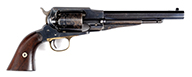
EXCEPTIONAL MARTIALLY MARKED CIVIL WAR REMINGTON NEW MODEL ARMY PERCUSSION REVOLVER.
SN 122959. Cal. .44. Blue finish with 8″ oct bbl, pinched post front sight & 3-line address. “PATENTED SEPT. 14 1858 / REMINGTON & SONS. ILION NEW YORK U.S.A. / NEW MODEL”. Trigger guard is brass and it is mounted with 2-pc walnut grips and has a crisp, clear cartouche on left side. PROVENANCE: The Estate Collection of Phil A. Bleakney, Jr. CONDITION: Very fine+, all matching including grips, bbl, loading arm and frame retains about 95% glossy orig blue. Small nicks and scratches, some losses at muzzle. Cylinder retains 70% orig blue with one large patch flaked to a grey/blue patina. Hammer retains bright case colors. Grips are sound, solid, well fit with several large gouges on butts. Mechanics are crisp well defined bore. 49059-151 JS (3,500-5,500) – Lot 1109
EXCELLENT CIVIL WAR REMINGTON NEW MODEL ARMY REVOLVER.
SN 80982. Cal .44 Very fine example of the 2nd heaviest used martial Civil War revolver CONDITION: Very fine overall, retaining about 90% bright finish with flaking on cylinder & loading assembly. SNs all matching. Stocks are sound, solid, well fit with bright, crisp cartouche and small inspector marks on most parts of gun. Mechanically gun functions well with bright shiny bore. 49598-5 JS (2,000-3,000) – Lot 1110
VERY RARE RAPHAEL DOUBLE ACTION CENTER FIRE REVOLVER.
SN 393. Cal. 11 MM 6″ bbl, blue finish, plain walnut grips with buttcap and lanyard ring. CONDITION: Very good. Bbl retains 70% blue finish with numerous scratch marks overall and wear at muzzle. Bbl is unmarked. Bore has eight-groove rifling which is strong. Bore is frosty. Cylinder retains 80% blue finish with slight drag mark and front edge wear. Cylinder loading plate retains traces of case color in protected areas. Trigger guard and backstrap retain 30% flaking blue. Trigger retains 50% blue. Hammer retains 10% blue. Wooden grips are good with numerous mars and dents overall . SN 393 is stamped on bbl lug on left side of frame. No other apparent marks. A very rare revolver for the advanced collector. 49547-2 TEP C&R (3,000-5,000) – Lot 1115
SN 1147. Cal. 36. Popular and unusual Civil War era revolver purchased by both the Army & Navy, a total of 11,984 guns were purchased by the government of the approx. 20,000 produced. It has 7-1/8″ oct bbl with tall brass pin front sight and 3 line markings on top strap “SAVAGE R.F.A. CO. MIDDLETOWN. CT / H.S.NORTH PATENTED JUNE 17 1856 / JANUARY 18 1859, MAY 15 1860”. It has a 6-shot smooth cylinder with detachable revolving ratchet and a heart-shaped trigger guard with ring trigger & standard trigger. Ring trigger cocks the hammer, rotates the cylinder & the normal trigger fires the revolver. Fitted with 2-pc matching numbered smooth walnut grips. Since this gun has no inspector mark or inspector cartouches it was probably made for the private market to be sold to an Army officer or anyone wanting this massive Navy caliber revolver. This gun is in extremely fine condition retaining much of its orig finish. PROVENANCE: The Estate Collection of Phil A. Bleakney, Jr. CONDITION: Very fine overall. All matching. Bbl retains about 80% orig factory blue. Frame retains strong traces of orig blue in protected areas with balance brown/plum. Trigger & trigger guard retain areas of muted case color with balance grey/brown. Hammer retains about 20-30% orig case colors. Cylinder retains about 60% orig blue with balance a grey/brown patina. Mechanics are crisp, bright shiny bore with crisp rifling. Stocks are sound, solid and well-fit, with a few small dings, dents and scratches as can be seen in photos. 49059-148 JS (2,500-4,500) – Lot 1125
EXCEPTIONAL AND SCARE CIVIL WAR ALLEN & WHEELOCK CENTER HAMMER LIPFIRE ARMY REVOLVER.
SN 84. Cal. 44. Blue finish with 7-1/2″; oct to rnd bbl, pinched post dovetail brass front sight. Left side of bbl flat marked “ALLEN & WHEELOCK. WORCESTER. MASS. US / ALLEN’S PT’S. SEPT 7. NOV 9. 1858”. Cylinder is 6-shots, unfluted with notches cut near rear outside edge for protrusion of lip. There is a hinged door on right side of frame for cartridge introduction, serial numbered to match gun. Mounted with smooth 2-pc varnished walnut grips with matching serial numbers internally on each. This revolver has the unusual feature of bayonet latch cylinder pin like on percussion models, but heavier. This is a rare gun to find in high condition as only about 250 were manufactured and these prior to the percussion models; both being popular sidearms among Union officers. PROVENANCE: The Estate Collection of Phil A. Bleakney, Jr. CONDITION: Extremely fine. Bbl retains 60-70% bright blue finish with remainder flaking to a grey/brown patina. Frame retains 80%+ orig bright finish with main reductions on grip straps. Cylinder retains about 70% bright blue finish with light drag line. Hammer, loading gate, trigger and extractor lever retain some light case color with balance silver/grey. Stocks are crisp, sound and well fit retaining virtually all of their orig vanish with slight edge wear and minor dents and bruises. 49059-136 JS (4,000-6,000) – Lot 1126
SN 4472. Cal. .44. 7-1/2″ bbl, blue finish, plain walnut grips, left grip has matching SN and clear “RPB” cartouche, right grip is numbered 4226. Revolver shows “B” inspector marks on bbl, frame, and cylinder. SNs on frame, loading lever, cylinder, and butt are all matching. Rogers & Spencer, Utica, NY is stamped on top strap deeply and clearly. US Ordnance contracted for 5000 of these revolvers in November of 1864, but only 1500 were delivered by end of April 1865. No records indicate issuance of gun. In 1901, Bannerman of NY acquired almost entire lot and offered them to collectors. That accounts for fine mint condition of which many specimens are yet seen. CONDITION: Fine. Bbl retains 80% bright blue finish with some light pitting on top of flat near frame and some staining on left side. Bore is dark with strong rifling. Loading lever assembly retains 80% muted case color. Cylinder retains 80% bright blue with drag mark and wear at front. Frame retains 80% bright blue with some flaking behind hammer and on top strap. Hammer retains 50% muted case color. Backstrap retains 50% blue with flaking at top. Forestrap and butt retain 80% blue with high point wear. Grips are very good with sharp cartouche and only minor dents and scratches at butt. Small chip missing from heel of left grip. A very fine example of a relatively rare Civil War era revolver. 49550-1 TEP C&R (3,500-5,000) – Lot 1129
CIVIL WAR GREENE BREECH LOADING PERCUSSION CARBINE.
SN 1363. Cal. .54, 18″ rnd bbl. Gun has small British proofs on most every part and a large crown over “VR” on lock just forward of “MASS. ARMS CO / CHICOPEE FALLS/U.S.A. 1856”. Tang is marked “GREENE’S PATENT / JUNE 27TH 1854.”. Primer door is marked “MAYNARD’S PATENT SEP.22 1845”. This is a unique and scarce arm made in the US for British contract prior to American Civil War. PROVENANCE: The Estate Collection of Phil A. Bleakney, Jr. CONDITION: Very fine overall, bbl and receiver retains about 80% of its thinning blue finish. Breech is gray/brown overall with staining and light pitting. Lock and hammer and Maynard primer door retain muted case colors being overall silver/gray with crisp markings. Stock is sound and well fit with numerous small storage dings, dents and scratches. Buttplate and patch box have traces of finish, overall gray/brown with light pitting. Mechanically gun is excellent with bright, crisp bore. 49059-242 JS (4,000-6,000) – Lot 1136
SN 2069. Cal. .50. About 1,500 of these guns were made for James Warner by the Massachusetts Arms Company circa 1864. Brass breech block hinged on the right side, extraction by manual slide at bottom rear of forestock, 20″ rnd bbl with iron barrel band, 2-leaf rear sight and unique Warner half rnd steel front sight. Buttstock and frame have small inspector letters, left side of frame marked “JAMES WARNER, SPRINGFIELD, MASS”. PROVENANCE: The Estate Collection of Phil A. Bleakney, Jr. CONDITION: Fine overall, bbl retains about 90% thinning blue, appears touched up. Brass is smooth with yellow brass patina. Stocks are sound and solid with hand worn patina, there is a crack in forestock forward of ejector lever. Mechanically gun is sound with crisp fine shiny bore. 49059-240 JS (3,000-5,000) – Lot 1137
EXCELLENT JOSLYN MODEL 1855 “MONKEY TAIL” CARBINE.
SN H9. Cal. .54, 22-1/2″ rnd bbl, brass mounts. Lock plate marked “A.H. Waters & Co. /Milbury, Mass”. Breech lever is marked “PATD BY / B.F. JOSLYN. / AUG. 23, 1855”. This example is in exceptional condition being possibly unfired, retaining raised grain, case colors and most of the original bbl browning. PROVENANCE: The Estate Collection of Phil A. Bleakney, Jr. CONDITION: Bbl retains 90%+ original brown finish, lock is smooth with traces of case color overall gray. Breach retains thin muted case color with balance silver/gray, with areas of staining and pin prick pitting. Brass mounts are smooth with staining. Stock is sound, well fit with raised grain, oiled finish, a few small dents that do not affect aesthetics. Mechanically gun is fine with crisp, bright bore. 49059-239 JS (3,000-5,000) – Lot 1138
GWYN & CAMPBELL CIVIL WAR CARBINE IN NEARLY NEW CONDITION.
SN 2382. Cal. 52. This is among the finest examples of a popular Civil War carbine in nearly new condition. All serial numbers on gun are matching. Gun is marked rear of lock, “GWYN & CAMPBELL” in an arch above “PATENT/1862/HAMILTON O”. Frame is stamped “UNION RIFLE” vertically below breech. An inspector’s cartouche “WHR” is crisp and found in stock opposite lock. Gun retains most all its original blue and original case colors as can be seen in photos. PROVENANCE: The Estate Collection of Phil A. Bleakney, Jr. CONDITION: Bbl retains 95%+ original blue though fading. The bore is crisp and appears unfired. The lock, frame and lever retain 95% of their bright case colors with remainder muted. The breech block and backstrap retain about 90% of their bright fire blue with areas of pitting and staining. Stock is fine and solid, well fit. Inspector marks on comb and cartouche are crisp and easily read. Stock has several small storage dings and scratches. Mechanically gun is functional with a crisp shiny bright bore. 49059-228 JS (3,000-5,000) – Lot 1139
SN NSN. Cal. 50. 20″ bbl. This is a extremely fine example of the first bolt action metallic cartridge arm accepted by the U.S Government. Only about 1,000 of these guns were made by Lamson & Company in Windsor, Vermont and delivered in April 1965. These were not issued to troops due to cessation of hostilities. This gun conforms to the standard configuration of other specimens and marked like others “US/EG Lamson & Co/Windsor VT” and “1865″ on lock and on back of breech “WM Palmer/Patent/DEC.22.1863″. This is a beautiful example of this carbine which would be difficult to upgrade. PROVENANCE: The Estate Collection of Phil A. Bleakney, Jr. CONDITION: This gun is excellent overall. Bbl retains most of its original finish turned mostly plum with small areas of pin prick pitting. Rifling in bore is excellent, crisp, well defined and shiny. Lock, hammer, trigger guard, bbl band and buttplate retain most of their original bright case colors. Buttplate has collection number stamped at bottom and four tack holes are found on right side of buttstock where a plate has been removed. Otherwise stock is excellent with areas of raised grain, crisp cartouche and minor storage dings, dents and scratches. Mechanically gun is excellent. 49059-233 JS (3,000-5,000) – Lot 1140
EXCELLENT JENKS NAVAL CARBINE WITH MAYNARD TAPE PRIMER.
SN 2069. Cal. 54. Unusual side hammer carbine with 24-1/4″ rifled rnd bbl, integral front sight on front brass band with smooth brass middle band, both screwed to forestock. Fitted to lock under hammer is Maynard tape primer mechanism. This scarce variant only occurs on about 1000 guns made by Remington. It has usual “USN” markings with “RP” (Richard Paine) inspector initials and the date “1847″ with “W.JENKS” and “CAST-STEEL” on top flat of bbl. Lockplate has usual markings “REMINGTON’S/HERKIMER/N.Y.” This scarce variant of a Jenks carbine rarely comes to market and this is a beautiful example retaining most of its orig finish that would be difficult to upgrade. PROVENANCE: The Estate Collection of Phil A. Bleakney, Jr. CONDITION: Very fine overall. Bbl retains 95%+ orig brown finish though thinning in areas with staining and light pitting. Lockplate & hammer retain strong traces of case color with balance a smooth silver/gray. Brass is a yellow polished patina. Loading lever on top retains about 50% thin blue finish with staining. Stock is sound and solid with scattered storage dings, dents and scratches with well defined inspector’s cartouche. Mechanics are excellent, crisp bright bore. 49059-241 JS (3,000-5,000) – Lot 1141
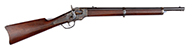
SN 15058. Cal. .54, About 20,000 of these popular brass mounted carbines were made during the Civil War, most saw hard use. 21″ rnd bbl, with 2-leaf rear sight and fixed front sight. Markings include on top of bbl just forward of 2-leaf rear sight “STARR ARMS CO YONKERS,NY”. The same marking is found in two lines on lock & “STARR’S PATENT, SEPT.14TH 1858″ is stamped on back of breech. Most parts have small sub-inspector letters & stock has two large cartouches which read “JTB” (James T Baden, Inspector 1862-1864). Bbl is inspected “HGS” on left side near breach. Buttstock has interesting inspector mark on top of comb near butt “LAB” (Lester A Beardslee, LT. CDR., USN). It is rare to find such a fine example retaining most of its original finish and raised grain wood. PROVENANCE: The Estate Collection of Phil A. Bleakney, Jr. CONDITION: Very fine overall, bbl retains 95%+ original blue though dull. Sights, screws and trigger plate retain most of their original bright fire blue. Lock, hammer and lever retain about 50% bright and muted case colors with balance silver/gray. Frame retains thin muted case colors with overall blue/gray patina. Stocks are sound, well fit, with bruising from saddle ring over one cartouche. Forestock has bruising and blemishes forward of band. Both stocks have scattered storage dings, dents and scratches. Mechanically gun functions well with crisp, shiny, bright bore. 49059-232 JS (3,000-5,000) – Lot 1142
SN NSN. Cal. 50. This is a popular Civil War era carbine of which about 1,000 were made. Marked on left side of receiver is “E.G. Lamson & Co / Windsor / VT / US / Ball’s Patent / June 23, 1863 / Mar 15, 1864″. This interesting patent arm was operated by a lever which also acted as the trigger guard. This is a nice example of seldom offered Civil War era carbine in near new condition that would be difficult to upgrade. PROVENANCE: The Estate Collection of Phil A. Bleakney, Jr. CONDITION: Bbl retains almost all its orig finish which is now a dark plum color with a bright mirror-like bore with crisp rifling that appears unfired. Frame, lock, breech, lever & buttplate retain most of their bright case colors with balance a silver/gray. Stock is sound & solid, well-fit with raised grain with scattered small storage dings & dents. 49059-235 JS (3,000-5,000) – Lot 1143
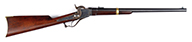
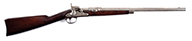
SN 23264. Cal. 56-50. Standard Spencer carbine marked “SPENCER REPEATING RIFLE CO. BOSTON. MASS. PAT’D MARCH 6, 1860″. Made with Stabler patented magazine cut-off. It has 20” rnd bbl, 6 lands & grooves, square base front sight with Spencer ladder rear sight with tension spring. This gun retains bright orig finish and fine stock. This is a very fine and scarce (only about 1,000 were produced) example of a late Civil War and early Indian War military carbine that generally saw hard use and finding examples in high condition such as this are difficult today. PROVENANCE: The Estate Collection of Phil A. Bleakney, Jr. CONDITION: Very fine overall. Bbl retains 95%+ original finish though much is thinning and turning plum, small areas of pin prick pitting. Lock, frame & hammer retain much of their original case colors with balance silver/grey with staining and pin prick pitting. Stocks are sound and well fit, buttstock has several storage dings & dents but cartouches are fairly crisp and well discerned as seen in photos. Mechanically gun functions well with bright crisp bore. 49059-236 JS (3,000-5,000) – Lot 1144
SN C45480. Cal. .52, Standard carbine with usual markings throughout. It has a 22″ round bbl. Bbl is marked forward of sight “Sharps Rifle/Manufg. Co/Hartford Conn” and rear of sight on bbl “New Model 1865″. Frame and hammer have Sharps and Lawrence patent marks as usually seen and typical sling bar and ring on the left side. This is a fine example of the final production of the Civil War Sharps military carbine with only approx 5000 units produced. PROVENANCE: The Estate Collection of Phil A. Bleakney, Jr. CONDITION: Bbl retains about 90% of thinning dull blue finish with several large scratches and scuffed areas. Lock, hammer and frame retain much of their muted case colors with scattered areas of staining and pin prick pitting. Stocks are sound and solid with areas of raised grain with scattered areas of staining and small dings and dents. Gun mechanically is excellent with bright, shiny bore. 49059-238 JS (3,000-5,000) – Lot 1145
SN 17089. Cal. 52. This gun conforms to other guns of this pattern with 21″ bbl and about 39″ overall. PROVENANCE: The Estate Collection of Phil A. Bleakney, Jr. CONDITION: Extremely fine and all matching. Bbl retains about 95% of its original thin blue finish though most has turned plum. The frame, lock and hammer exhibit bright case colors though muted in areas with balance silver/gray. The breech lever & backstrap exhibit 95%+ bright brilliant blue. Buttstock is sound and solid with crisp cartouches and some raised grain with scattered tiny scrapes, scratches, dings & dents from storage. Forestock is fine overall with similar cosmetic defects as buttstock. Mechanically sound and bore is bright & crisp. 49059-229 JS (3,000-5,000) – Lot 1146
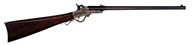
SN 23564. Cal. 50. This standard second model also known as the model-1863 Maynard Carbine had production of just over 20,000 arms between 1863 – 1865. “1865” stamped on trigger plate just rear of lever and this example retains most of its orig finish & has possibly never been fired. This gun conforms to other known models with 20″ oct to rnd bbl, pinched front sight & 3-leaf adjustable rear sight. Left side of frame has sling bar & carbine ring. Stock is straight-grain walnut with 2 crisp inspector cartouches which both read “JM” (Julian McAllister). Small sub-inspector letters found on most other parts of gun. This is a very fine example of this popular Civil War gun that has few defects. PROVENANCE: The Estate Collection of Phil A. Bleakney, Jr. CONDITION: This gun is excellent overall. Bbl retains 95% orig blue finish though dull. The bore exhibits crisp mirror-like shine with well-defined rifling. Frame and lever retain much of its orig muted case color with balance a silver/gray. Buttplate retains 50% bright blue finish with balance plum with areas of rust & pitting. Stock is sound & solid with raised grain with numerous small storage dents, dings & scratches with crisp, like-new inspectors’ cartouches. 49059-234 JS (2,500-4,500) – Lot 1147
SN 11957. Cal 50. 21-5/8″ bbl. Fine example retaining much of its orig finish that conforms to the standard configuration of this arm with part oct bbl, with adjustable rear sight and fixed front sight with German silver blade. On the left side of breech is marked “ADDRESS/POULTNEY&TRIMBLE/BALTIMORE, U.S.A.” and “SMITH’S PATENT/JUNE 23 1857″, and also the 3-line markings on the contractor, “MANUFACTURED BY/AM’N M’CH’N WKS/SPRINGFIELD MASS”. PROVENANCE: The Estate Collection of Phil A. Bleakney, Jr. CONDITION: Fine overall, bbl retains 95%+ thinning blue finish. Hammer, frame and breach retain muted case colors with an overall smooth gray/brown patina. Sights, breach strap, trigger guard and buttplate retain about half of their original blue finish. Stocks are well fit, refinished and retain most all of their newer varnished finish. Mechanically gun is excellent with bright, shiny bore. 49059-230 JS (2,500-4,500) – Lot 1148
SN NSN. Cal. .58. 20” rnd bbl. This is the first type marked “EDWARD LINDNER’S / PATENT. / MARCH 29. 1859.” on top of the breechblock/loading chamber. Inspector initials appear on various parts of the gun. Only 892 of these were made, 391 of which were received by the Ordnance Dept. in November of 1861 and issued to the First Michigan Cavalry. PROVENANCE: The Estate Collection of Phil A. Bleakney, Jr. CONDITION: Good to very good overall, gun appears all original and matching. Metal with old cleaning is overall bright/gray with scattered staining and light pitting. Stock is well fit with hairline crack just forward of lock. Mechanically gun functions, with crisp discernible rifling in bore. 49059-243 JS (2,500-3,500) – Lot 1149
SN NSN. Cal. 50 RF. This gun is in near-new condition & appears unfired retaining most of its orig finish & conforms to other known carbines with 20″ Round bbl with single leaf rear sight. Case hardened frame and back action lock. Left side of receiver is marked with “Peabody’s Patent July 22, 1862 Manf’d by Providence Co Prov. RI”. Saddle ring is on loop on left side. Buttplate and bbl band are case hardened. PROVENANCE: The Estate Collection of Phil A. Bleakney, Jr. CONDITION: Bbl retains 95%+ orig blue finish though turning plum with scattered stains with crisp mirror-like bore. Lock, frame, breech & lever retain much original bright case colors with balance silver/gray. Stocks are sound & solid with raised grain & small “WC” cartouche is crisply struck. Most all metal parts have small sub-inspector letters similar to those found on U.S. martial arms. 49059-227 JS (2,500-4,500) – Lot 1150
SN NSN. Cal. 50 RF. This gun is in near-new condition & appears unfired retaining most of its orig finish & conforms to other known carbines with 20″ round bbl with single leaf adjustable rear sight. Case hardened frame and back action lock. Left side of receiver is marked with “Peabody’s Patent July 22, 1862 Manf’d by Providence Co Prov. RI”. PROVENANCE: The Estate Collection of Phil A. Bleakney, Jr. CONDITION: Bbl retains 95%+ orig blue finish though thin with foreign proof on right side of bbl just forward of band. Lock, frame, breech & lever retain much original bright case colors with balance silver/gray. Stocks are sound & solid with raised grain & small “WC” cartouche is crisply struck initials not being easily discernible. Most all metal parts have small sub-inspector letters similar to those found on U.S. martial arms. Mechanically gun is excellent with crisp, shiny bore. 49059-231 JS (2,000-3,500) – Lot 1151
SN 778 C. Cal. 44 Rimfire. The Whitney – Howard lever action hammerless single shot breech loader better known as the Howard Thunder Bolt was manufactured between 1866 – 1870. Bbl length: 24-1/2”. Marked “MANUF’D. FOR-HOWARD-BROS.-BY-WHITNEY-ARMS-CO.-WHITNEYVILLE-CONN.” on the right side of the bbl. “C. HOWARD PATENTED.SEPT. 26 &OCT 10.1865-OCT. 28 1862” on the left. PROVENANCE: The Estate Collection of Phil A. Bleakney, Jr. CONDITION: Fine overall, bbl retains about 30% of its original blue finish with balance blue/plum, other metal is gray/plum. Stock is sound and solid. Mechanically gun functions with crisp well discerned bore. 49059-114 JS (1,000-2,000) – Lot 1153
REMINGTON SINGLE SHOT BREECH-LOADING CARBINE U.S. CONTRACT MODEL, A.K.A. “SPLIT BREECH REMINGTON”.
SN 640. Cal. 46 RF. 20″ bbl, blue and case color finish, straight grained walnut stocks, saddle ring and bar on left side of receiver. U.S. inspected and cartouched. These carbines were made under sub-contract from Remington by the Savage Revolving Arms Company of Middletown, Ct. Made circa 1865 & 1866, This is Remington’s earliest production long arm chambered for metallic cartridge ammunition. Small inspector marks are present on metal parts. CONDITION: Very fine. Bbl retains 75% blue finish turning to a pleasing plum-brown. An area of roughness about 5″ long on right side of bbl as a result of poor handling. Bore is bright with strong rifling. Sights are excellent. Bbl band and retainer spring retain 90% case colored finish. Receiver retains 30% case colored finish with balance drifting to a pleasing gray-brown patina. Right side of receiver has some scratching. Screws in receiver are fine retaining much of straw finish. Breechblock and hammer retain 50% black blue finish. Stocks are very good with some slight handling marks and bruises, especially on left side of forend. Buttstock shows clear cartouches and a “P” proof. Buttplate retains 90% fiery case color with some wear at heel and toe. A very fine example of a very rare early Remington carbine. 49547-5 TEP C&R (3,000-5,000) – Lot 1154
VERY FINE SPRINGFIELD ARMORY ALTERATION OF CIVIL WAR MODEL 1860 SPENCER CARBINE FOR INDIAN WARS.
SN 34006. Cal. .50, This is a very fine orig and authentic Civil War Spencer carbine that was altered after the Civil War by Springfield Armory with three groove rifle sleeve and “Stabler Cut-off” device which allowed gun to be utilized as a single shot. This gun conforms to other early issued Spencer carbines with markings on receiver flat “SPENCER REPEATING/RIFLE CO BOSTON MASS/PAT’D MARCH 6 1860.” PROVENANCE: The Estate Collection of Phil A. Bleakney, Jr. CONDITION: Fine to very fine overall, bbl retains 20 – 30% original blue finish, being overall blue/brown with staining and pin prick pitting. Bore exhibits well discerned rifling with pitting. Frame exhibits much original Springfield Arsenal case colors, markings on bbl flat are weak and thin due to this arsenal refinish. Other metal is gray/brown. Stocks are sound and solid with no apparent inspection marks. Mechanically gun is excellent. 49059-237 JS (3,000-5,000) – Lot 1155
SN NSN. Cal. 58. This is a fine example of the unique and popular martial Civil War pistol-carbine. This gun conforms with other examples with rifled 12″ rnd/oct bbl marked at left breech “V/P” over eagle’s head and dated “1855″ forward of folding three leaf sight on tang. Lock marked on primer door with spread winged eagle and “U.S./SPRINGFIELD” in front of lock and dated “1856″ behind the hammer. Walnut stock has inspector cartouche. PROVENANCE: The Estate Collection of Phil A. Bleakney, Jr. CONDITION: Overall very good to fine, metal has been cleaned to a bright gray/white overall with scattered areas of pin prick pitting. Adjustable 3-leaf rear sight has crisp markings. Brass mountings are all cleaned and polished with a yellow brass color. Walnut stocks are sound and solid with old refinish such that edges are rounded and inspectors cartouche is only discernible in outline. Gun functions well including Maynard tape device (a roll of caps is found in device). Bore exhibits well discerned rifling with pitting. 49059-154 JS (3,000-5,000) – Lot 1159
VERY FINE MODEL 1836 U.S. MARTIAL FLINTLOCK PISTOL.
SN NSN. Cal. 54. This is a fine example of an unfired “ROBERT JOHNSON”, Middleton, CT contract single shot martial flint pistol. This gun conforms to the usual configuration with an overall length of about 14″. Lockplate is flat and beveled ahead of the hammer marked “US/R JOHNSON/MIDDn CONN/1841. PROVENANCE: The Estate Collection of Phil A. Bleakney, Jr. CONDITION: Bbl and iron mountings are overall bright/white with scattered areas of pitting. Case hardened lock and breech retain muted traces of their case colors though mostly grey. Stock is fine and solid with 2 bright well-struck cartouches “WAT” (William Anderson Thornton) & “JH” (James Harris). Wood still exhibits raised grain with scattered small scratches and overall hand worn patina. Bore is bright and shiny gun was possibly never fired. Small sub-inspector marks are found on trigger guard and bbl. 49059-138 JS (2,000-3,000) – Lot 1173
VERY FINE CIVIL WAR SMITH & WESSON MODEL ONE 2ND ISSUE SPUR TRIGGER REVOLVER.
SN 30799. Cal. 22 Short. Blue & silver finish with 3-1/4″ keyhole shaped bbl, German silver half-moon front sight, 7-shot unfluted cylinder and mounted with matching numbered 2-pc rosewood grips. PROVENANCE: The Estate Collection of Phil A. Bleakney, Jr. CONDITION: Revolver retains about 95% glossy orig blue with scattered areas of staining and pitting. Frame & grip frame retain virtually all of their orig silver plating, with small nicks and scratches. 2-pc grips are sound and well fit retaining 95% orig varnish with numerous small nicks, dings and scratches. There is a hairline crack about an inch long from the butt upward on right grip. Mechanics are fine, bright shiny bore. 49059-126 JS (750-1,250) – Lot 1324
EXTREMELY FINE CIVIL WAR ERA SMITH & WESSON #2 ARMY REVOLVER.
SN 12582. Cal. 32. This is an extremely fine example of the popular Civil War Smith & Wesson army revolver with 6″ bbl. Based on SN this gun was made near beginning of the war. PROVENANCE: The Estate Collection of Phil A. Bleakney, Jr. CONDITION: Gun retains about 95% of its orig bright blue finish on frame, cylinder and bbl with minor staining, patches of grey/plum patina. Maker and patent marks on bbl flat and cylinder are crisp and easily read as are serial numbers. Rosewood grips are sound and solid retaining almost all their original varnished finish. Mechanically gun functions well with crisp shiny rifling. 49059-131 JS (1,500-2,500) – Lot 1325
RARE COLT 1ST MODEL DRAGOON CARRIED BY HUGH ODOM 18TH REGIMENT TEXAS CAVALRY.
SN 7463/7715. Cal. 44. Colt First Model Dragoon has direct family descent in the Hugh Odom family. Hugh S. Odom was a member of a Texas cavalry unit and files of his military history are included in this report. It is most interesting that Hugh S. Odom went into the war with this gun and was actually paid by the state compensating him $75 for bringing in his own revolver. Identified Confederate Colts are quite rare, especially ones used by specific members of a Texas cavalry regiment. This gun was once part of the museum at Texas Tech University as noted by accompanying documentation, which identifies the gun a as Colt First Model Dragoon Cavalry Handgun SN 7463-Cylinder Number 7716 which has been changed in pencil to 7715 which is correct. This particular arm appears orig with some restoration such as grips and trigger being replaced as the original Texas Tech document states “handles and trigger are missing.” The restoration done at an unknown date is quite excellent and presents the gun quite nicely. The family retained a photograph of Hugh S. Odom pictured as a veteran wearing a Masonic pin on his overcoat dated January 4, 1905. Mr. Odom was the original owner of this firearm and he carried it while a member of the 18th regiment Texas cavalry. The 18th Texas had a most interesting history being part of Granberry’s Texas Brigade fighting in many of the battles in the west, finally being paroled at Greensboro, NC about May 1, 1865. In the national archives, a Texas roster roll index card state that Private H.S. Odom is found enlisting July 17, 1861 at Cannonville, Hayes County, Texas. This card notes that “while on scout July 17 to the San Saba River, Concho Springs,‘head of Llano and head waters of Devils River’, no fresh Indian signs were found”…second card in this file states “Enlistment March 4, 1862 12 months”. Mr. Odom’s age is listed as 27 living in Hayes City. The enrolling officer, R.N. Calhoun, noted to his account certain monetary amounts credited him for his horse, equipment, gun and pistol. This is unusual record showing that he was compensated $75 most likely for this Colt Dragoon revolver. In a State of Texas pension document (see addendum) signed in 1898 by Mr. Odom stating his military service, he states that he served in Company F, 18th Texas Cavalry, under Colonel N.H. Darnell. He also states “I never received a dollar from the government in my life and received no pay for my service.” Odom further states that he served in Company F 18th Texas Cavalry under Colonel N.H. Darnell, enlisting January 8, 1862 and served until the surrender of General Lee in 1865.” This is a most historic first model Dragoon with written provenance from recent family descent stating past owners in family. Albert G. Odom was Hugh S. Odom’s grandfather. Albert Odom was a county judge in Stanton, TX in the early 20th century and family legend states he used his gun as protection in the court. A bound report & appraisal on this gun accompanies which include family letter of provenance and war records. PROVENANCE: Hugh S. Odom, 1834-1918; Robert Odom Gray (great-grandson). CONDITION: Good to very good. Sound and complete with restored grips & trigger as stated above. SNs matching with exception of cylinder which is noted above appears orig to its time of use. Metal overall is brown/grey with areas of staining and pitting. Markings crisp & discernible as can be seen in photos. 49300-1 JS (12,000-15,000) – Lot 3132
EXCEPTIONAL CIVIL WAR COLT MODEL 1860 FLUTED ARMY PERCUSSION REVOLVER.
SN 5198. Cal. 44. Usual configuration with 8″ rnd bbl, German silver front sight and 1-line New York address with dashes. Frame is 4-screw style cut for shoulder stock. Left side of frame has a tiny “COLTS PATENT”. Cylinder is 6-shots, and full fluted. The silver plated brass trigger guard & steel backstrap contain a varnished 1-pc walnut grip. Given that this model of Colt made its debut shortly before the onset of the Civil War and there are records of many deliveries to Southern distributors, some just days before the shelling of Fort Sumter. Many of these early fluted Army’s made in 1861 are considered to be possibly Confederate arms. This gun possibly could be researched from Colt and other sources that have listed many fluted SNs over the years. Regardless, of who carried this gun during the Civil War, either a Northern or possibly Southern soldier, it has survived in beautiful “as found” condition, retaining much of its orig finish and very superior to most encountered fluted Colt Army revolvers. Accompanied by a four page R. L. Wilson letter which describes the gun’s configuration and condition. He also confirms that the gun appears in the Colt Civil War Shipping Ledgers as follows: .44 caliber, 8-inch barrel, blued and plated finish. Shipped to Wm Read & Son, Boston, Mass, July 16th 1861, in a five gun shipment. PROVENANCE: Greg Martin Auctions, Lot 1225, December 8, 2003; The Estate Collection of Phil A. Bleakney, Jr. CONDITION: Fine, all matching including bbl, frame, trigger guard, backstrap, cylinder, wedge and arbor. Grips are unnumbered but fit gun very well and match overall condition and no doubt appear orig to this gun. Bbl and cylinder retain about 60% orig blue turning to grey/plum with streaking. Cylinder has patent information into flute and SN stamped on back of cylinder which still retains 3 complete safety pins and 3 that are smashed or partially smashed. SNs and other markings on gun are well struck and easily discerned as can be seen in photographs. The frame, hammer and trigger guard retain some muted case colors with balance a silver/grey with scattered staining and pinprick pitting. Brass trigger guard retains about 40% orig silver plating. Iron backstrap retains about 10% bright blue finish with balance matching rest of gun. Grips are sound and well fit showing light to moderate edge wear retaining over 95% orig varnish. Mechanics are fine, strong bright bore with crisp rifling. 49059-59 JS (10,000-15,000) – Lot 3147
VERY FINE CIVIL WAR MARTIALLY MARKED COLT MODEL 1860 ARMY PERCUSSION REVOLVER.
SN 67875. Cal. 44. This is a fine example of a martial 1862 US government purchased Colt Army revolver. Blue & color case hardened with 8″ rnd bbl, German silver front sight and 1-line Colt U.S. America address. Frame has “COLTS PATENT” stamped on left side and is 3-screw style. Cylinder is usual rebated style with 6-chambers and Ormsby Naval battle scene roll marking. All of the safety pins are crisp and serviceable. The brass trigger guard & iron backstrap contain an oiled 1-pc walnut grip. Both sides of grip have discernible cartouches and several of the metal parts have inspector initials. According to Flayderman’s Guide to Antique American Firearms about 127,000 Model 1860 revolvers were purchased by the Federal Government for use in the Civil War. The vast majority of these revolvers were issued to front line troops and was the most extensively used handgun throughout the Civil War. They mostly saw continuous service throughout the war and later on the American frontier, usually under harsh conditions with limited or no maintenance and are rarely found today in such extremely fine condition seeing honest use with good care. Note: the extensive muzzle wear from being taken in and out of holster but gun still retains excellent finish, mechanics and aesthetics. PROVENANCE: The Estate Collection of Phil A. Bleakney, Jr. CONDITION: Very fine overall. All matching including bbl, frame, trigger guard, backstrap, cylinder, stocks and grips. Wedge was not numbered. Bbl retains over 80% orig blue with much of balance plum with scattered small dings and dents around wedge slot. Finish at muzzle around front side is dull though feathering is still visible and discernible muzzle wear on right side. Frame, hammer, and loading arm retain muted case colors with balance silver/grey. Cylinder retains traces of orig blue in safety slots and shows virtually all of its crisp and well discerned Ormsby Naval battle scene with some wear at high spots and light pitting around front edge. Trigger guard has yellow patina with initials “JFK” stamped on left side. Backstrap retains strong traces of bright blue in protected areas with balance matching patina to rest of gun. Grip is sound, solid and well fit with good discernible inspector cartouches though worn around edges. Grip has moderate edge wear with several dings, dents and scratches. Mechanics are fine. Bore is crisp and well defined with areas of staining and light pitting. 49059-55 JS (7,500-12,500) – Lot 3149
RARE FACTORY ENGRAVED COLT M-1851 PERCUSSION NAVY REVOLVER INSCRIBED TO CAPTAIN JULIUS HAYDEN, LATER BRIGADIER GENERAL.
SN 63812. This is a fine “as found” Colt Navy orig manufactured in 1856. This gun was originally manufactured under the U.S. Military contract and was rejected for unknown reasons. Sam Colt, being the frugal businessman that he was, put burl grips on the gun, had it engraved, and likely sold it to the public. Most parts have inspector’s initials and a small “U.S.” is found on left side of frame beneath “COLT’S PATENT”. This exact gun is written about on page 85 of Nathan L. Swayze’s book “’51 Colt Navies”. Regardless, this is a engraved and inscribed Colt Navy carried by Julius Hayden who saw continuous service in the U.S. Army as an officer from 1850 to 1870. The backstrap is inscribed “Captn. J. Hayden. U.S.A.”- with the U.S.A standing for United States Army. Captain Hayden was orig commissioned in the 2nd U.S. Infantry seeing service in the west until the Civil War when he was commissioned into the Field and Staff of the 10th U.S. Infantry in the Army of the Potomac. Captain Hayden advanced through the ranks and by the time of the Battle of Gettysburg, he was Inspector General of the 3rd Corp. He is cited in several references as personally leading the 3rd AC to the Gettysburg battlefield as he was acquainted with the terrain. Lt. Col. Hayden was cited by Major General French of the 3rd Army Corps for distinguished and conspicuous ability. Hayden was indeed brevetted Brigadier General for gallant and meritorious service during the Civil War. There are over 100 pgs of copied records of Bvt. Brig-General Julius Hayden outlining his war service beginning in the Mexican War, wounded during this war, with his first promotion in 1850 to Captain until his retirement in 1870. This is a rarely offered inscribed and engraved Colt to a regular U.S. Army officer in fine unaltered matching condition. CONDITION: Gun appears all-orig with matching SNs. Full-coverage engraving of bbl, frame, backstrap, and trigger guard even include screws with exception of hammer screw and wedge screw which appear to be contemporary replacements with matching patina. Metal overall is gray/plum with fairly sharp edges with edge wear. Cyl shows traces of naval battle scene with an old repaired chamber which is barely detectable without close scrutiny. Backstrap and trigger guard retain about 50% of their orig silver plating and hold a fine varnished 1-pc burl grips. Mechanically, revolver functions well with well discerned rifling in bore. This gun no doubt was carried by Hayden throughout the Civil War. 49622-6 JS (16,000-25,000) – Lot 3167
FINE CIVIL WAR COLT MODEL 1861 PERCUSSION NAVY REVOLVER WITH CARVED PATRIOTIC IVORY GRIPS.
SN 13476. Cal. 36. Usual configuration with 7-1/2″ rnd bbl marked “ADDRESS COL. SAML COLT NEW-YORK U.S.AMERICA” with dashes. Left side of frame marked with small “COLTS PATENT” and a small “36 CAL” on left rear of trigger guard. German silver front sight, smooth unfluted cylinder with Ormsby naval battle scene; brass grip frame and carved “certifiable antique ivory” grips with most unusual carving of Lady Liberty slaying a sea serpent on left grip. This gun was made in 1863 at the height of the Civil War and this most unusual depiction of Lady Liberty slaying a serpent where the serpent no doubt represents the Confederacy. This gun has survived quite nicely retaining much orig finish and fine aesthetics. PROVENANCE: The Estate Collection of Phil A. Bleakney, Jr. Special Note: This item contains or is made of ivory. Do not bid on this lot unless you have read and agreed to our "Ivory Position Statement" and the "Waiver of Legal and Financial Risk to James D. Julia in regards to your Purchase of an Ivory Object." This information is located in the front section of our catalog. CONDITION: Fine overall. All matching, partial SNs found on bbl, frame, trigger guard, backstrap, cylinder, arbor and wedge. There are no SNs internally on ivory stocks or ivory grips, but grips are made in correct Colt style with beveled edges and are made with 2 slabs adjoined by screwed wood blocks which is most typical of Colt factory guns of the Civil War era. Stocks fit into frame well, but appear slightly smaller than the overall grip frame. Bbl retains about 30% bright blue finish especially in protected areas with balance plum/brown patina with a few scattered nicks, dents and scratches especially around wedge slot. Frame, hammer and loading arm retain about 30% case color with balance being silver/grey with staining and rust on loading arm. Cylinder is an even medium grey/plum patina with traces of blue in safety slots and retains rolled 90% naval battle scene. Grip frame and trigger guard retain about 20% of their orig silver plating with balance a yellow mustard patina. Gun is mechanically sound, crisp fine rifling in bright bore. 49059-61 JS IVORY (7,000-10,000) – Lot 3178
FINE PRESENTATION 1ST MODEL MERWIN & HULBERT ARMY SINGLE ACTION REVOLVER.
SN 6379. Cal. 44 M&H. Nickel finish with 7″ rnd bbl, integral front sight and 1-line Merwin & Hulbert address on top with Hopkins & Allen manufacturer’s address on left side. It has square butt grip frame with lanyard swivel and is mounted with red & black marbled, checkered hard rubber grips. This is the 1st type revolver with open top frame and scooped flute cylinder. Back strap is engraved in period script “A.H.B. to F.C.B. 12/25.78”. The SN is found on butt strap and assembly “3850” is on the left side of butt strap under the grip, also on cyl spindle, rear face of cyl and rear face of bbl lug. Production figures for the Merwin & Hulbert are unknown but Flayderman’s Guide to Antique American Firearms states that production is estimated at only a few thousand. Merwin & Hulbert were not themselves manufacturers but dealers & promoters who contracted the manufacturing process to established firearms makers, in this case Hopkins & Allen. These revolvers were very popular on the American frontier with lawmen & others for their rapidity of unloading & reloading. Once all the cartridges were fired, a simple twist & pull of the bbl/cyl assembly emptied the cyl which could then be re-closed and rapidly reloaded through the loading gate on right side of frame. Unfortunately by the time the Merwin & Hulbert emerged on the scene Colt had a 3-year head start with their distribution system and in government contracts. In addition the early Merwin & Hulbert revolvers were introduced in their proprietary calibers such as found here. That ammunition was not always readily available which depressed sales until the company began chambering their revolvers in standard calibers. Merwin & Hulbert marketed these fine revolvers in several different models and calibers only from 1876-1880. CONDITION: Extremely fine plus, all matching except grips which are unnumbered. Overall retains virtually all of its fine orig nickel finish with only some very fine pin prick flaking on sides of frame. Hammer retains about all of its orig case colors, turned a little dark. Grips are crisp, mechanics are crisp, brilliant shiny bore. 49450-12 JR (17,000-25,000) – Lot 3264
SN 102. Cal. 58 CF. SN 102. This rare rifle, one of possibly only two known, certainly few were ever made. It was made by Remington in 1867 from leftover Zouave rifles & was likely not acceptable to the military due to the heavy caliber, especially since the lighter 50-70 caliber was already in production. This rifle was one of two in the Remington Factory Museum & was de-accessioned in the 1940’s to reduce the size of the collection. It is described as having the orig Zouave bbl, 32-1/4” long, with saber bayonet lug on right side, orig front sight & 2-leaf, 3-position rear sight with orig Zouave brass furniture consisting of a nosecap, two bands, buttplate & small patchbox. Recess under patchbox has hole for spare nipple. It has a regular rnd top rolling block action with a sling loop in front web of trigger guard. The number “102” is stamped in the stock on bottom left front side of wrist by trigger guard. The number “175” is found on left side of top tang, under the wood and the number “23” is found on left side of butt. The number “5” is found on tang screw, which is also case colored. There are tack holes on bottom of stock, reportedly from where the brass Remington museum tag was removed. Accompanied by an orig unmarked brass handle bayonet with 20-1/8” Yaghtahan blade with a small “H” inspector mark on handguard and a “B.H.” on back of grip. It has its fine orig brass & leather scabbard. PROVENANCE: The William Smith Collection. CONDITION: Extremely fine. Bbl retains about all of its glossy, bright, orig blue with some slight bayonet wear at muzzle. Receiver & trigger guard retain virtually all of their brilliant, orig case colors. Breechblock & hammer are in the white. Wood is sound with a series of small dings on forestock & light handling & storage marks on buttstock. Mechanics are crisp, bright shiny bore. Bayonet is very fine to extremely fine. Blade is bright with light surface discoloration, mostly on left side. Handle is clean. Scabbard is slightly crackled. 49312-71 FTL351 (7,000-10,000) – Lot 3274
EXCEPTIONAL CIVIL WAR REMINGTON MODEL 1863 ZOUAVE PERCUSSION RIFLE AND BAYONET.
SN NSN. Cal 58. 33″ bbl. This is a beautiful example of the popular Remington Civil War rifle in extremely fine condition. This gun conforms to standard configuration with blued rnd bbl with “VP”/eagle head proofs and “1863″ date on bbl tang. Left side of bbl stamped “STEEL” followed by “RKA” (Remick K. Arnold) inspector mark, 2-leaf rear sight and distinctive Remington part cylindrical front sight and bayonet lug. This gun is brass mounted with two spring retained bbl bands, nose cap, trigger guard, buttplate & patchbox. These brass components each have small brass inspector’s initials being “L”, “C”, “J” or “B”. Stock has two crisp inspector cartouches which read “HDJ” (Henry D Jennings) and “BH” (Benjamin Hannis). Accompanying bayonet is also inspected “BH” for Benjamin Hannis. This is a fine, complete and orig example of the popular brass mounted Remington rifle with beautiful stock and metal retaining much of its orig finish with a like-new shiny bore and excellent matching bayonet and scabbard. PROVENANCE: The William Smith Collection. Formerly from the Dr. Miller Estate Collection. CONDITION: Extremely fine. Appears to be unfired retaining virtually all of its orig factory finish to both metal & wood with minor nicks, dings & a few light bruises in wood. Lockplate & hammer retain strong case colors, more faded on hammer. Bbl has a small band of wear just in front of rear sight. Mechanics are crisp, brilliant shiny bore. 49312-72 FTL (6,000-8,000) – Lot 3275
EXTREMELY FINE MODEL 1853 “JOHN BROWN” SHARPS CARBINE – ONE OF THE FINEST OF ITS TYPE.
SN 18911. Bbl. 21-1/2″. This is a standard Model 1853 Sharps carbine in which about 10,000 were made between 1854-1858. Many of these slant breech Sharps saw service during the Civil War, both North and South, by “Border Ruffians” and anti-slavery zealots in Kansas during the tumultuous time before the Civil War when Kansas was “Bloody Kansas”. John Brown made this model most famous when he raided Harper’s Ferry in an attempt to cause a slave rebellion in America. This particular gun has standard markings associated with this model. Bbl. marked “Sharps Rifle/Manufg. Co. /Hartford Conn”. Tang marked “Sharps/Patent/1848” and serial number “18911” and matching serial number on bbl. Lockplate is marked “Sharps/Patent/1852”. This is an especially fine gun that has sub-inspector initials “JPC” stamped in wood opposite lock and single inspector letters externally on buttstock and top of Bbl. breech. This same sub-inspector initials “JPC” are found on another carbine SN 17861 with inspector’s cartouche “RHKW” which no doubt was one of the 250 very rare martials referred to in Flayderman, George Moller in volume III, pg. 228 American Military Shoulder Arms states these guns were issued to the First Regiment of Dragoons as experimental arms in the Pacific Dept. We can’t state this gun is a martial for sure, however sub-inspector marks indicate some military use. This gun retains most of its orig finish. Similar examples are rarely offered or encountered and this is certainly one of the finest examples extant. CONDITION: Bbl. retains about most of its slightly thinning blued finish with remainder a mottled plum/blue with areas of staining and light thinning. Frame retains 30-40% muted case colors. Brass mounts are smooth with mustard colored patina. Stocks are sound, well fit with some raised grain, though superb overall. Inspector’s initials are crisp and easily read. The bolt face appears nearly unmarked leading one to believe this was a scantly used gun. Mechanically, gun functions well including pellet priming system. Bore is bright and crisp with a pit or two. 49632-2 JS (12,500-17,500) – Lot 3301
VERY RARE AND FINE SPRINGFIELD MODEL 1855 CAVALRY CARBINE.
SN NSN. Fine rare carbine with 22″ rifled rnd bbl, half moon pinched front sight and 2-leaf rear sight. Top rear left of bbl is marked with “V”, “P” and eagle head proofs. Lockplate has a small American eagle over a tiny “US” in front of hammer with “SPRING / FIELD / 1854″ vertically behind the hammer. The date “1855″ is also stamped on the top of tang. Mounted in a 1-pc walnut stock with long wrist and about 3/4 length with brass nosecap and iron furniture. Bottom of bbl at the muzzle has integral large ring to which is attached a large wire loop containing a captive button-head ramrod. Trigger guard is 2-pc with a large round cavalry sling ring in the rear. Buttplate is smooth carbine style with “US” on the tang. These rare carbines of which about 1000 were made saw use on the frontier primarily in Texas and New Mexico prior to Civil War. In 1856 Lt. Col. Robert E. Lee was assigned to Camp Cooper, Texas, in command of two squadrons (8 companies) of cavalry whose assigned duty it was to control the Indians on the frontier. Lt. Col. Lee’s troops were issued both Springfield carbines and Springfield musketoons and in June 1856 he led four squadrons of cavalry, armed as noted above, on a 40-day, 1,600 mile campaign against the Indians. Many 1855 carbines were captured by the Confederacy when they captured the San Antonio Arsenal. It is ironic that surviving carbines are rarer than the Confederate version copied by Billharz & Hall of Pittsylvania Court House, VA of which only about 500 were made. This is a nice example of a rare primary U.S. military carbine. CONDITION: Very good to fine. Appears orig and complete. Metal has old cleaning and is gray-white overall. Bbl and lock markings are easily discerned as can be seen in photographs. Brass nosecap has mustard colored patina. Stock is sound and solid with some raised grain and hand-worn patina. Reverse forestock has numerous small dings and dents between bbl band and escutcheon. One inspector’s cartouche is discernible in profile opposite lock. There are two 1-1/2″ hairline cracks on bottom of forestock just forward of trigger guard and between trigger guard and lock. A small set of inspector’s initials “JH” are found behind trigger guard. Mechanically, gun functions well with a good crisp discernible rifled bore. 49632-1 JS (12,500-17,500) – Lot 3302
SN NSN. This is a scarce andpopular Civil War era carbine of which only about 1,000 were made. Marked on left side of receiver is “E.G. Lamson & Co / Windsor / VT / US / Ball’s Patent / June 23, 1863 / Mar 15, 1864″. This interesting patent arm was operated by a lever which also acted as the trigger guard. This is an extremely nice example of seldom offered Civil War era carbine in near new condition that would be difficult to upgrade. CONDITION: Bbl retains almost all its orig finish which is now a dark plum color with scattered small areas of staining with a bright mirror-like bore with crisp rifling that appears unfired. Frame, lock, breech, lever & buttplate retain over 95% bright case colors with balance a silver/gray with scuffs at toe of buttplate and areas of staining ans soiling. Sub-inspector marks are found on most every piece of this gun & a crisp cartouche which reads “GGS” (G. G. Saunders) is stamped in stock opposite lock & a small “GGS” is found stamped on top of buttstock comb. Stock is sound & solid, well-fit with raised grain with scattered small storage dings & dents. 49622-5 JS (6,000-10,000) – Lot 3303
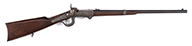
SN 11307. Cal. 54. This is an very fine example of the popular Civil War 5th model Burnside carbine. This gun exhibits bright blue finish, bright case colors and crisp inspector cartouches “GC” (George Curtis) on a raised grain stock. This gun conforms to other guns of this pattern with 21″ bbl and about 39″ overall. Markings are crisp and as typically found on breech, bbl & lock, as can be seen in photos. This gun was designed by the Civil War General Ambrose Burnside. The cartridge this carbine used was one of the most unique of the Civil War being a “ice cream cone” shaped brass casing though this was still a percussion arm. The breechblock mechanism is hinged to allow easier loading of the unusual cartridge this carbine used. ‘Burnside’s Patent Model of 1864’ stamped on the top of the frame identifies this rifle as a ‘5th Model’, which was the one which was most commonly used during the Civil War. PROVENANCE: The William Smith Collection. CONDITION: Very fine and all matching. Bbl retains about 80% of its thin orig finish though most has turned plum with scattered areas of staining. The frame, lock and hammer exhibit bright case colors though muted in areas with scattered areas of staining. The breech lever & backstrap exhibit over 90% bright brilliant blue. Buttstock is sound and solid with crisp cartouches and some raised grain with scattered small scrapes, scratches, dings & dents. Forestock is fine overall with similar cosmetic defects with about 2″ area of larger dents on bottom between breech and band. Mechanically sound and bore is bright & crisp. 49312-77 FTL (4,000-6,000) – Lot 3304
SN 2409. Cal 50. 21-5/8″ bbl. About 30,000 of these well made carbines were made for the Civil War, this is a very fine example retaining most of its orig finish that conforms to the standard configuration of this arm with part oct bbl. This gun is properly iron mounted, case colored & blued. On the left side of breech is marked “ADDRESS/POULTNEY&TRIMBLE/BALTIMORE, U.S.A.” and “SMITH’S PATENT/JUNE 23 1857″, and also the 3-line markings on the contractor, “MANUFACTURED BY/AM’N M’CH’N WKS/SPRINGFIELD MASS”. Military sales of the Smith were handled by Poultney and Trimble of Baltimore, and units known to have received the Smith were the 3rd West Virginia Cavalry, the 7th and 11th Illinois Cavalry, the 1st Connecticut Cavalry, the 7th and 17th Pennsylvania Cavalry, the 6th and 9th Ohio Cavalry, and the 1st Massachusetts Cavalry. The action of the Smith Carbine breaks open in such a way that the chamber is broken between the front and rear of its dimensions. This was incorporated in the design of the weapon to facilitate quick removal of spent rounds. PROVENANCE: The William Smith Collection. CONDITION: Overall very fine to excellent condition, retaining 95% orig blue turned mostly plum on bbl with fine bore and crisp rifling. Case colored frame & hammer exhibit over 90% bright case colors with remainder silver/brown. Trigger guard, breech band & buttstock ferrule retain over 80% orig blue. Stocks are fine overall, with some raised grain, no inspector cartouche though sub-inspectors initials “HJ” on stock. A large letter “B” is found externally stamped on bbl& buttstock. Mechanically gun functions well with crisp shiny bore which appears unfired. 49312-76 FTL (4,000-6,000) – Lot 3305
MODEL 1855 PERCUSSION PISTOL CARBINE WITH MATCHING SHOULDER STOCK.
SN NSN. Cal. 58. This is a fine “as found” example of this popular martial Civil War pistol-carbine of which many say early Civil War service in the South. This gun conforms to other examples with rifled 12″long rnd/oct bbl marked at left breech “V/P” over eagle’s head forward of folding three leaf sight on tang. Lock marked forward of Maynard primer device (which door is missing). “U.S./SPRINGFIELD” and dated “1855″ behind the hammer. Walnut stock has inspector cartouche barely discerned in outline. Gun appears orig, authentic and uncleaned “attic condition” overall. Ramrod, brass nose cap, brass bbl band and swing swivels all fine. Butt cap numbered “12″ as is its attached stock. It is always difficult in this model to find matching assembly numbers which this example exhibits. This is a very fine well patinaed example of matching carbine and stock which most saw hard use during the Civil War. CONDITION: All metal well patinaed brown/grey with pitting, especially around breech. Adjustable three leaf rear sight still functional and complete. Brass mountings exhibit matching mustard colored patina with numerous small stains and scratches. Walnut stocks are sound and solid with good, fairly crisp edges, hand worn patina, several small scuffs, dents and dings especially to butt stock. Single cartouche is barely discernible in outline. Impressed line where buttstock fits into grip is present on either side. Gun functions well including Maynard tape device though door is missing. Mechanically gun holds full cock but not half-cock, otherwise mechanically sound. Bore exhibits well discerned rifling in a pitting bore. 49366-1 JS (5,000-7,000) – Lot 3306
RARE CIVIL WAR CASED ENGRAVED METROPOLITAN ARMS NAVY PERCUSSION REVOLVER.
SN 2046. Cal. 36. Metropolitan Arms is a very close copy of Colt Navy revolvers and most schools of thought believe there was cooperation between Colt and Metropolitan as so many of the parts are interchangeable. Engraved Metropolitan’s are quite rare and this gun is engraved much like a factory Colt of the Civil War era. This example most likely being engraved by a good New York shop such as Nimschke, exhibiting fine scroll and punch dot patterns on bbl housing, muzzle, loading arm pivot, frame, backstrap & trigger guard. The cylinder has the most unusual rolled engraved scene titled “NEW ORLEANS APRIL 1862”. Several of Farragut’s ships along with a prominent Confederate Ironclad with Confederate flag are seen; this is a scarce cylinder scene. This gun overall is an honest, very good used condition where markings are all crisp and discernible. CONDITION: Gun is overall very good and all matching. Engraving and cylinder scene are all very discernible. Metal overall is grey with strong traces of bright blue finish, especially in protected areas such as bottom of bbl. Gun appears orig and complete though latch is possibly a contemporary replacement or at least trimmed from its orig wider configuration. Backstrap and trigger guard retain traces of silver plate in protected areas. Stocks are well fit with strong traces of orig varnish with scattered small nicks & bruises. Gun is functionally fine with one nipple broken. Bright, crisp, well defined bore with light pitting. Accompanying casing is in matching very good condition containing a brass flask with double-sided panoply of arms and eagle, an L-shaped Colt gun tool which is refinished, and a 2-cavity Colt bullet mold with rare military inspector marks. Round cardboard box of New York patented caps is retained along with a 1863 dated store card which reads “JOHN SCHUH’S SALOON 88 FIRST AVENUE NY”. 49254-14 JS (12,500-17,500) – Lot 3307
SCARCE CIVIL WAR MARTIALLY MARKED PETTENGILL ARMY PERCUSSION REVOLVER.
SN 4447. Cal. 44. Blue finish with 7-1/2″ oct bbl and nickel silver cone front sight. Bottom of frame marked with small shield and “PATENTED / NOV 4 1862”. Top strap marked “PETTENGILLS/PATENT 1856 & PATD JULY 22 1856 / & JULY 27 1858”. Cylinder is smooth and unfluted with 6 chambers and very large nipple recesses and stamped with SN 4447. Mounted with smooth 2-pc walnut grips with flared bottom edges, stamped matching numbers to this revolver. Left grip has a “WW” (William Walters) inspector’s cartouche with small “WW” initials on various parts. According to Flayderman’s Guide to Antique American Firearms there were only about 3,400 of these scarce pistols manufactured for Pettengill by the Rogers, Spencer & Co. in the early 1860s. U.S. Ordnance Dept. initially contracted for 5,000 of these pistols in 1861 but in June 1862 reduced the order to 2,000. The contract was completed between October 1862 and January 1863. They were issued to the 3rd Michigan Cavalry, 3rd & 5th Missouri Militia, 1st Arkansas, 3rd Illinois and 3rd Kentucky during the Civil War. This is a fine example of a rarely offered high conditioned Civil War martial Army revolver. PROVENANCE: The Estate Collection of Phil A. Bleakney, Jr. CONDITION: Very fine, all matching including frame, grips and trigger guard, and cylinder. Bbl retains about 95% glossy orig blue with scattered spots of light surface rust and sharp edge wear. Frame, grip frame and trigger guard retain about 10% glossy orig blue with the majority of loss areas on the rear part of frame, grip frame and trigger guard. The loss areas are a grey/brown patina. Cyl retains 40% glossy orig blue with front edge wear and numerous small longitudinal scratches. Grips are sound with sharp, completely legible cartouche, showing very little wear and retain virtually all of their orig oil finish. Mechanics are fine. Bright shiny bore with blue finish in bore and chambers. 49059-152 JS (4,000-6,000) – Lot 3308
EXTREMELY FINE AND RARE CIVIL WAR BUTTERFIELD ARMY PERCUSSION REVOLVER.
SN 96. Cal 41. This is among the finest if not the single best Butterfield Army Revolver we have seen. This gun conforms to other noted examples with smooth, non-fluted 5-shot cylinder with thin knurled forward edge. Marked on top strap in 3 lines “BUTTERFIELD’S PATENT DEC 11 1855 PHILADA.”. There were only about 600 of this secondary US martial pistol made and they are rarely seen in such high condition as this example. PROVENANCE: The Estate Collection of Phil A. Bleakney, Jr. CONDITION: Very fine to excellent overall. Matching SNs are found on most every part, even internally small parts bear the #96. Bbl and cylinder retain about 90% orig finish, though some thinning and turning plum. Brass frame, backstrap and sideplates retain about 50% of their dark finish. Hammer retains some case colors with balance silver/blue. Grips are sound and solid though right grip at frame has a hairline crack on right side that is barely discernible. Stocks retain about 80% of a varnished finish. Mechanically, gun functions and has a crisp bright bore. 49059-153 JS (5,000-8,000) – Lot 3309
FINE MAINE FAMILY ESTATE GROUPING OF CIVIL WAR MEMORABILIA INCLUDING FINE COLT ARMY WITH HOLSTER AND FINE MODEL 1860 SPENCER CARBINE.
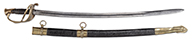
SN 89999/34909. Cal. 44/56-56. This is a most unusual grouping brought in to our auction by a Portland, Maine family whose deceased father had donated two orig fine military photographs (copies can be seen on web) of unknown family members to the Portland Historical Society. Both photographs are officers and at least one family member according to consignor was in the famous 1st Maine Cavalry. This grouping is all in remarkable “as found” condition. 1) Spencer Carbine SN 34909 is early production retaining orig finish and good inspector cartouches, well above average for surviving specimens. 2) Martial Colt Model 1860 SN 89999 Army Revolver with regulation holster in very fine condition, Colt retains much of its orig finish. 3) Fine Ames Model 1840 cavalry saber with excellent grip wrap. 4) Sword belt with eagle buckle with applied silver wreath complete with two hangers. 5) Spencer Carbine box in excellent condition with 7 orig. cartridges, as found in rifle’s magazine. 6) Regulation Civil War percussion cap box with large inspector stamp on front in oval “R.WHITE SUB INSPECTOR US ORD. DEPT”. 7) Regulation pistol cartridge box in very fine condition, maker marked “H.A. DINGEE NY”. 8) Fine officers regulation silk sash with unusually large knotted tassel ends. A bit heavier than most. Measuring 12″ long including knots. CONDITION: 1) Spencer, Very good to fine overall. Bbl retains strong traces of orig thinning blue with balance a mottled plum. Other metal components are grey/brown overall with areas of staining and pitting. Some muted case colors are still seen on protected areas of frame, breech and cartridge tube latch. Stocks are sound and solid and well fit with typical scattered light storage blemishes. Two cartouches are still discernible “MMJ” (Martin M. Johnson) and “DAP” (Daniel A. Perkins). The last line of patents under manufacturers mark is lightly struck as can be seen in photos. Mechanically, carbine is well functioning with crisp discernible bore. 2) Colt Army, very good to fine overall. Bbl retains 10% plus orig bright blue finish, especially in protected areas with balance grey/plum. Cylinder retains strong traces of bright blue finish, especially in protected areas with balance grey/plum. Cylinder scene is crisp and well defined. Frame exhibits about 80% muted case colors with balance grey/silver. Loading arm and hammer have strong traces of darkened case colors. Backstrap retains over 80% thinning bright blue color. Frame and bbl screws retain about half of their thin fire blue color. All SNs are matching externally, gun was not disassembled as it appears so untouched and orig. Stocks are sound, solid and well fit with thin applied shellac or varnish, inspector cartouches are only visible in silhouette with light edge wear. Mechanically, revolver functions well with crisp well defined bore with areas of pitting. The accompanying holster is sound, supple, complete with tab and plug. There is a large set of inked initials inside flap which possibly read “SBP”. Surface of holster has crazing, scuffs and loss of color in areas. 3) 35-1/2″ blade, full firm marked “AMES MFG CO / CABOTVILLE / 1849”, inspected “US” and “WD” opposite firm name. Blade is grey overall with scattered areas of staining and pitting. Retains orig protective leather washer. Grip is tight, retaining virtually all of its orig leather with orig “shine”, complete twisted wire. Brass hilt has mustard colored patina with old cleaning, scabbard is solid with iron patina. Grey/brown overall. 4) Buckle and keeper fit fairly well, though bench numbers do not match. Belt is supple and as noted with unusual tooling, more like an officers with two sword hangers attached by leather loops that are not sewn. One of these leather loops appears much more recent than the other but sewn the same. 5) Early Spencer cartridge box maker marked “E. GAYLORD CHICOPEE MASS”. Wood block insert contains 20 drilled holes for cartridges. Box overall in fine condition retaining both roller buckles wit. Box has crazing and scuffing but retains most of its finish. Tab is worn and crazed; missing above half of its finish, but intact. 6) Very good to fine. Easily read inspectors marks, missing lambs wool and pick. 7) Very good to fine overall, retaining most of its orig finish with scuffs and crazing where flexed. Tab is solid and intact retaining about 75% of its finish. 8) Very good to fine overall. Sash appears relatively intact with small reductions. One knot heavily frayed over wooden top, but tassels on both appear complete and intact. 49629-1 JS (6,000-10,000) – Lot 3342
CIVIL WAR SLOUCH HAT, HARDEE HAT, TINTYPE OF POLHEMUS SMITH, 9TH NEW YORK HEAVY ARTILLERY.
Just found in upstate New York estate were two fine Civil War hats along with small box containing 1/6th plate tintype of soldier full view with musket and gear wearing kepi with crossed cannons, most likely a “9” and “I” above and below the insignia. There is an 1889 & 1890 reunion ribbon for the 9th NY and the bottom of box is written “Polhemus Smith’s hat cord, buttons and badges from the war”. Box does contain a hat cord, GAR hat insignia, and eight GAR buttons. A quick search of the internet for Polhemus Smith shows him enlisting in the 9th NY Heavy Artillery, Company I, 12/21/1863, and being transferred in June 1865 to the 2nd NY Light Artillery, and later a promotion 7/6/1865 as an Articifer. Both pieces of head gear appear original and as found. The slouch hat has a wide 2-1/4″ hard sweatband with a 3/8″ sewn binding. It also has about 1/2″ wide black & brown binding with a small japanned brass buckle and hat cord, all which appear orig to hat, including the embroidered U.S. hat insignia which is sewn with the same contemporary thread found attaching band. Hardee hat has 2″ thin Moroccan sweatband with a small pasted Army contract label inside top of crown. A fairly tattered feather is sewn to side of hat terminating in a silk cockade. Around crown is a 5/8″ binding with similar binding around edge perimeters. We have no doubt both of these hats are Civil War, though slouch hat appears to be a smaller size than the Hardee. Though the hats have no names or Unit markings, we are only guessing that these Civil War hats were his or his family because of the identification of the other artifacts found in same yard sale. Regardless, this is a fine pair of Civil War field hats rarely found “undisturbed”. CONDITION: Thread box that holds buttons, insignia, photograph and ribbons is broken at corners, but has preserved the ribbons and buttons quite well. Tintype shows good contrast with considerable crazing, small creases and rust on reverse. There is an accompanying single Belgium or European shot pistol in poor to fair condition overall, old cleaning, rust & pitting overall, is not mechanically functional. Hardee hat is sound & solid, sweatband is complete, orig, as is. Contract label which is marked “Size No. 7 U.S. Army J.J.&I. Phillips”. Hat has several holes at perimeters of crown. Feather cockade firmly attached, both being worn. Binding ribbons both fairly complete with wear & reductions, some loose threads, as can be seen in photos. Hat overall is dirty, soiled with some mildew. Left side was originally sewn to body, and small cuts are seen in front inside of hat where Jeff Davis hat insignia & other insignia were originally attached to the front. Slouch hat is very good overall with several holes from insects. Binding worn at edges. Sweatband has several tears, but is otherwise complete. 49083-1 JS (6,000-8,000) – Lot 3343
FINE AND HISTORIC CIVIL WAR US MODEL 1861 3-INCH ORDNANCE RIFLE RECENTLY DISCOVERED IN MASSACHUSETTS BARN.
SN 534. Cal. 3″. This was the most widely used rifled cannon of the American Civil War, and was made of wrought iron of John Griffen’s patent. It has a 3” bore, is 69” long and weighs 816lbs. A correct carriage would add about 900lbs. A one-pound charge will fire a 9.5lb solid projectile 1,830 yards (5 degree elevation) at 1,215 feet/second. These 3” Ordnance Rifles were made at the Phoenix Iron Co., Phoenixville, PA, by modifying a procedure being used in the production of wrought iron for lighthouse construction, which involved welding together bundles of wrought iron rods and then processing them through a rolling mill. Wrought iron was expensive and difficult to work with at the time. The Phoenix foundry took strips of wrought iron ¾” wide and 4.5” thick and wrapped them by lathe around an iron core. Five layers were built around the core with a thin iron covering on top. Then the core was removed and a plug was driven into the breech, which closed the breech and formed the cascabel. The tube was then heated to welding temperature and up-set 2” in a press. It was rolled out from 4.5 to 7 feet and the bore was reamed out. The rifle was made with .5” wide lands and grooves that were .84” wide. Finally, the case was turned down to proper size in a lathe and trunnions were welded on. This produced a lightweight 3” rifled, muzzle-loaded gun, with clean lines of almost exact weight throughout manufacture. It was an enormously strong gun tube and exceptionally safe. The other wrought iron weapons of the day, the most popular being the Parrott gun, were prone to bursting, as wrought iron is brittle. This cannon was indeed the workhorse of field guns during the Civil war both North and South. The light weight of the 3” Ordnance Rifle made it highly mobile and thus, the preferred weapon of the Horse Artillery. This weapon was popular with Artillery on both sides and prized for its endurance, efficiency and long-range accuracy. It normally fired Hotchkiss, Parrott or Schenkel shells, canister & caseshot. The Phoenix Iron Co. supplied the U.S. Army with 1,100 of these weapons by war’s end, each marked on the muzzle. This example has the inspector’s initials “CCC” (Lt. Clemens Clifford Chafee), the registry number “534”, the weight, “816lbs” and date of manufacture “1862”. The Confederacy acquired many of their 3” Ordnance Rifles through pre-war purchases and captures. The 3” Ordnance Rifle was an important technological advancement in artillery leading to modern weaponry. It typifies the truism that the American Civil War was the last 18th Century war and the first 20th Century war. The 3” Ordnance Rifle was the epitome of muzzle-loading artillery of the American Civil War and remained the primary field gun in the U.S. inventory well into the 1880s when it finally gave way to steel, breech-loading artillery. This particular tube has had a long association with Gettysburg battlefield with consecutive registry number 533 owned by the park. It is noted that this tube mistakenly was added to inventory by an accompanying letter from Gettysburg park superintendent Edward Clark that states its clear title being offered here. Of the 67 Ordnance rifles inspected in October and November 1862 by Lt CC Chaffee, 25 survive and half are owned by the National Park Service, mostly at Gettysburg. Inspector Chaffe graduated near the top of his class at West Point in 1862 and was immediately stationed inspecting cannons before he was given a field command as engineer in Grant’s army at Vicksburg using some of the same cannon he had inspected. Lt. Chaffee was breveted Captain for Gallant Service and Meritorious Services during the siege at Vicksburg on July 4, 1863. Chaffee would return to services as Ordnance Officer first at the Allegheny Arsenal in Pennsylvania and later at the Springfield Armory where he died suddenly July 5, 1867 at the age of 26. This is a fine Civil War field artillery cannon that would mount on carriage easily. CONDITION: Cannon is very good overall with good iron patina and discernible markings as can be seen in photographs, though the last digit of registry number on muzzle is only partially seen but still distinct. The US surcharge on top of bbl is crisp and well defined. Rifling in bore is discernible though pitted. Brass vent is very good with smooth green patina. Pendulum sight mount is still attached rear of vent though ears to hold pendulum axle are beaten down. 49540-1 JS (20,000-30,000) – Lot 3350
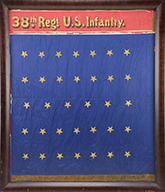
HISTORIC AND IMPORTANT FLAG OF THE ALL BLACK 38TH REGIMENT US INFANTRY.
Surviving Civil War and Indian War flags of all black American regiments are almost non-extant in institutional collections and more so the private sector, this most likely being the only one to ever be offered in an international auction. The 38th all black US Infantry was first established on July 18th, 1866. It was stationed in New Mexico territory for the purpose of protecting workers from hostile Indians along the Transcontinental railroad route then being constructed. This was among the first totally segregated all black units formed after the Civil War. This unit prior to reorganization was originally the 38th US Colored Infantry Regiment which was formed in 1864 and fought in operations around Petersburg and Richmond for the remainder of the war. During these actions around Richmond, three members William Barns, James Harris, and Edward Ratcliff would be awarded the Congressional Medal of Honor (the 38th USI would see five more Medal of Honor recipients during the Korean War). At the end of the Civil War the 38th was moved to service station near Galveston, Texas. The 38th USCT was mustered out of service January 25th, 1867, just after the formation of the 38th United States Infantry. Interesting historical note, is the induction of Cathay Williams as the first African-American woman to enlist, and the only documented woman to serve in the United States Army as a man, under the pseudonym William Cathay. Her story is chronicled in the St. Louis Daily Times in January 1876. The 38th US Infantry would have three short years of service being consolidated into the 24th infantry regiment in March of 1869, when this flag would have been retired. West Point at one time had a great number of colors of the early colored troop flags and black regimental flags. The 38th USCT once at West Point is no longer in existence as many of the poor condition silk flags were deassessed or just thrown out in the 1940’s. There is no record of the 38th US Infantry flag ever at West Point. It is most likely these colors were retained by Brevet Colonel Merriam when the regiment was consolidated in 1869. The 38th is noted to have been involved in at least three battles with Indians during their tenure, June 26th, 1867 Wilson’s Creek Kansas, July 29th, 1867 near Fort Hayes, and March 26th, 1869 in the San Francisco mountains New Mexico. Black infantry units often fought besides their counterparts in the cavalry (Buffalo Soldiers). Regardless this is the only 1860’s vintage American National colors of a historic black regiment probably to be ever offered in an international auction. CONDITION: Originally this flag would have measured 6′ x 6′ square, all that is retained is the complete Canton measuring about 39″ x 39″ with 34 two inch double applique gold painted stars, along with middle red strip with unit designation displayed above. Of note is that flag is 34 star, where 36 star would have been proper configuration, however it is noted to be quite common that surplus Civil War flags saw continued use well into the 1870’s with new designations. Flag has been framed and has not been dismounted, but it appears to have been mounted utilizing straight pins to hold sections in place. Color is very good, there is some flaking to gold paint in lettering and portion of 2 letters are missing. Portion of stripes can still be seen attached to Canton as is original gold fringe on bottom edge of Canton and edge of stripe. 49357-1 JS (6,000-8,000) – Lot 3353
Please Note: The exact size of the flag is not in the description. The dimensions are 47″ hoist x 49.5″ fly.
Please Note: The information from the paperwork originally prepared by Howard Michael Madaus in December of 1996 concerning this flag specifically notes, “Temporarily on loan at the Mariners Museum, Newport News, VA and eventually sold to Dr. Charles V. Peery (Charleston, S.C.) in 1979”. Therefore the reference in the description of the Ex-Maritime Museum, Southport, N.C. is incorrect.
FINE & HISTORIC ARMY OF NORTHERN VIRGINIA BATTLE FLAG CARRIED BY TUCKER’S NAVAL BRIGADE AT BATTLE OF SAILOR’S CREEK.
This ANV (Army of Northern Virginia) Seventh Bunting regulation battle flag issued in March 1865, is probably the only flag of its sort to have been carried by Confederate sailors and Marines during a Civil War engagement. The sailors of the gunboat CSS Nansemond, part of the James River Squadron under Admiral Raphael Semmes, were ordered to destroy their vessel on April 3rd, 1865 as were the crews of the rest of the squadron (three ironclads and nine gunboats in all). After doing so, they were to form with Semmes as infantry and head to Danville, Virginia to man the defenses there, that town having become the new Confederate capitol with the fall of Richmond. Somehow, some and possibly all of the Nansemond’s crew ended up with Commodore John Tucker’s Naval Brigade (Battalion) of sailors and Confederate Marines who had been manning the heavy guns at Drewry’s Bluff south of Richmond. Tucker’s men had come to Richmond from Wilmington, NC and Charleston, SC as those cities fell in February 1865. While Semmes’ men took the last train from Richmond, Tucker’s marched on foot to join with the retreating Army of Northern Virginia. This command was dubbed the Naval Brigade even though it contained no more than 500 men. On the drizzly morning of April 6, 1865 these sailors and marines trudged their way along the muddy roads as part of the rapidly fading hopes of the Confederacy. At about 10:00 AM, the enemy being discovered in close proximity, the brigade was formed in line of battle as part of the ad hoc division of George W. Custis Lee. This division, the rear guard of Richard Ewell’s Corps, contained Richmond defense troops, heavy artillerymen turned infantry including from Col. Stapleton Crutchfield’s Battalion and a few veteran units such as the 18th Georgia Battalion. During this last major engagement of the war in the east at the Hillsman House along Saylor’s Creek, a battle that was actually three separate fights, Lee’s division held for a time with fighting becoming hand to hand. The stalwarts were Tucker’s men who only surrendered when informed that all other Confederate units nearby had already done so. Their stand earned the respect of their Union foes. Of the 18,500 Confederates engaged, 7700 were killed, wounded or captured, including Crutchfield who was killed and Generals Ewell, Kershaw, G W. Custis Lee, Seth M. Barton, James P. Simms, Dudley DuBose, Eppa Hutton and Montgomery Corse and Commodore Tucker, all captured. This flag was donated by descendant of this brigade to the Mariner’s Museum in Wilmington, NC where it was later de-accessioned. The flag is shown in a 1938 Columbia, SC newspaper article telling of it’s history of being saved by B.C. Casey (misprint, it should have been D.C.) of Rolling Fork, MS. There is much conjecture over flag’s exact history as the last owners had all died prior to the 1938 article, but according to the research of various experts including letters by noted vexillologists Howard Madaus and Greg Biggs, the flag has a wonderful history. While claimed as a flag from the CSS Nansemond, it is possible that the flag actually represented Tucker’s entire Naval Brigade. There are over 100 pages of research and correspondence concerning this flag. Provenance is published online and should be read by interested parties. This fabulous flag is unquestionably an original and fine condition Seventh Bunting issue ANV battle flag and is among the few surviving, especially privately owned. Beautiful example, few better. PROVENANCE: Ex-Maritime Museum, Southport, NC. Ex-Collection of Dr. Charles Peery. CONDITION: Very good overall. Dark patination and color. Numerous small tears & holes as expected from battlefield use. 48942-1 JS (125,000-250,000) – Lot 3354
CONFEDERATE 1ST NATIONAL BATTLE FLAG OF THE 15TH SOUTH CAROLINA HEAVY ARTILLERY BATTALION “LUCAS ARTILLERY”.
This flag being offered comes from direct family descent being consigned by the great-great granddaughter of Maj. James Lucas. Maj. Lucas commanded the 15th South Carolina Heavy Artillery Battalion and brought this flag home after the war. This flag not only has great aesthetics but can also be traced to its date of manufacture and presentation. A historical report written by noted Confederate vexilliogist and historian Greg Biggs accompanies this flag. The flag is made from fine, light weight single-ply English wool bunting with stars of cotton and lettering made from originally red silk ribbon which has faded to pink where still remaining. Biggs, in his scholarly essay, notes that this flag was invoiced by the firm Hayden & Whilden under contract. Lucas Artillery Battalion was one of several coastal artillery units that protected Charleston Harbor. The battalion was formed June 6, 1861 on James Island where it was mustered into service. James J. Lucas was selected to command the battalion with the rank of Major. Lucas who was born in Kershaw County in 1831 was a son of a noted and prominent Charleston physician. James attended South Carolina Military Academy (the Citadel). James was prominent in the Charleston business community prior to the war and was elected to the state legislature where he served 3 terms. Lucas became part of the Palmetto Guards and served as their captain for 7 years leading up to the war. Upon the secession of South Carolina in December 1860, Lucas became aide-de-camp to Governor Francis Pickens. In that capacity he helped secure war supplies used against Ft. Sumter in April 1861. Lucas and his artillery were orig assigned to the fortifications on Sullivan Island, later moving to Cole’s Island guarding Charleston’s “backdoor” along Stono River and other points. It was here that the battalion gained their greatest success of the war. The USS Isaac R. Smith was a Union Navy blockading vessel that had seen pre-war service on the Hudson River until purchased by the Union Navy in 1861 for service along the coast. She weighed 450 tons and carried nine heavy guns. Her small size and shallow draft made her perfect for operations in the rivers around Charleston including on the Stono. The Confederates soon set a trap to capture the warship. On January 30, 1863, the Union vessel sailed up the river past masked Confederate batteries. Manning guns on one side of the river was a portion of the 15th South Carolina Heavy Artillery while a portion of the 2nd South Carolina Artillery covered the opposite shore. The Smith sailed past the batteries unaware of her predicament and anchored about 4-1/2 miles upstream by a local plantation. It was here that the Confederates opened fire on the ship. Another Union vessel sailed to her rescue but the rebel guns drove her off. Seeing the predicament he was in, the Smith’s commander stuck his colors. The Confederates recovered the ship, repaired it and renamed the CSS Stono. She then served as part of the Confederate Navy squadron around Charleston. Later becoming a blockade runner, she was wrecked at Sullivan’s Island bearing a load of cotton in June 1863. From August and into September, Lucas and his battalion fought in several engagements around Charleston harbor as the Union Navy tried to force entry into the harbor and were rebuffed time and again. Sites included in these fights included Battery Wagner, where two officers were killed, and Fort Sumter. In July 1864, Lucas’ Battalion defended Batteries Pringle and Tynes and defeated an attack by two Union ironclads and three gunboats. Finally, in late 1864, after Atlanta and Savannah in Georgia had both fallen, Union general William T. Sherman set his sights on South Carolina invading the state in early 1865. With the dearth of infantry units to defend it, some of the heavy artillery units about Charleston converted to infantry commands and Lucas and his battalion were so included. Attached to Rhett’s Brigade, Lucas and his troops fought at the battles of Averysboro and Bentonville in North Carolina between March 16 and 21, 1865. Lucas was wounded in both fights and sent to Raleigh to recover. He was there when General Joseph E. Johnston surrendered the Confederate forces in the region in late April 1865 including his battalion. Accompanying this lot supplied by family is a Polaroid photograph of Maj. Lucas’ grave and a frame post-war photograph, circa 1870. This is a fabulous and fresh historic and iconic “stars and bars” Confederate battle flag never previously offered from direct family descent. PROVENANCE: The flag comes from the Great-Great Granddaughter of Major James Lucas. Major Lucas also brought this flag home from the war. It was inherited upon the major’s death by his son, Benjamin Simon Lucas. Benjamin’s son, James Jonathan Lucas, inherited the flag and later gave it to his daughter Eleanor before his passing. Eleanor is the mother of the flag’s current owner who is the last of the Lucas family line on that side. CONDITION: Flag overall is in very good, sound, supple condition with bright colors, scattered small holes from moth damage. The silk ribbons are mostly missing which formed the letters on the flag. Flag measures 40-1/2″ on hoist and 63-1/2″ on fly. There is a 4″ sleeve made of orange cloth backed with polished cotton. The single applique cut-through stars measures 3-1/2″. The letters in unit name measure about 3″ and they are double applique. 49502-1 JS (40,000-60,000) – Lot 3355
Please Note: Since preparing the catalog description an in-depth report has been provided by noted flag expert, Greg Biggs. A description notes that the U.S. Naval Institute, where this flag was at one time on loan, identified this as a “Richmond Depot” flag. Mr. Bigg’s research has determined that it is actually a “Charleston Depot” flag.
FINE AND HISTORIC CONFEDERATE 2ND NATIONAL NAVAL FLAG CAPTURED BY THE 121ST NEW YORK INFANTRY DURING THE CIVIL WAR POSSIBLY FROM TUCKER’S NAVAL BATTALION AT SAILOR’S CREEK.
This Richmond Depot manufactured flag measures about 8′ x 12′ and was a typical ensign found on Confederate naval vessels and quite possibly the unaccounted for 3rd Tucker Brigade flag captured at Sailor’s Creek. This flag was on loan from the consignor “The Sleepy Hollow & Tarrytown Historical Society” to the Naval Historical Center for many years where it was studied and displayed. The orig tag from the curator of the Department of Navy Historical Society Center, Washington Navy Yard, Washington, DC is still tied to hoist. This well made flag is totally hand sewn with a canton measuring about 64″ x 60″. The entire height of hoist of flag measures 93-1/2″. Greg Biggs’ report on this flag gives more exacting measurements and proportions of this flag. The white field and red cloth of canton are loosely woven single-ply wool bunting as are the 8″ cut-through stars. The blue bunting that holds the stars is a more tightly woven single-ply bunting. The hoist measures 3″ of folded over linen forming a 1-1/2″ sleeve for rope which is still knotted with loops at each end. This is a beautiful and well presented naval flag, quite possibly captured at the Battle of Sailor’s Creek, April 6, 1865. “In the last desperate effort of Lee to save his army, the regiment (121st New York) in close combat with a brigade of Confederate marines, suffered severely, but captured several hundred prisoners and two stand of colors… By special request, the War Department gave the regiment permission to carry their captured battle flags to New York with them, and they marched down Broadway with their own colors, tattered and torn by shot and shell, and triumphantly carried their seven captured battle flags”. This quote was taken from a historical sketch of the 121st on the New York State Military Museum website where other information concerning unit and their captured flags are noted. Though we cannot be positive as to the ID of this flag, what we state is quite likely and knowing the history of the “Historical Society of Tarrytown and Sleepy Hollow being founding in 1889 where a small number of veterans of the Tarrytown Brigade of the Union Army (which served in the NY 32nd and NY 121st), having a profound interest in American history, combined their collections and established what is now called The Historical Society of Tarrytown and Sleepy Hollow, New York. One of the items donated was this Confederate naval flag…for decades, the flag hung in one of the two houses owned by the Historical Society. Nearly 20 years ago, it was loaned to the Naval Historical Center in Washington, DC (returned in 2010)…the 121st captured 8 Confederate flags at the Second Battle of Rappahannock Station and Sailor’s Creek; it is possible that the flag was taken during one of these actions…it is worth noting that the Historical Society retains fragments of the flag that flew over the capital in Richmond, signed by the Tarrytown soldiers who cut the flag down” (the 121st was the first unit to enter Richmond, April 2-3, 1865 according to NY State Museum website). Accompanying historical essay by CS flag expert and vexillologist Greg Biggs. CONDITION: Very good overall, strong bright colors, stitching strong and complete. There are scattered areas of moth tracking on red and white bunting. There are several larger holes which are quite possibly battle damage, the largest being about 6″ x 2″. The several larger holes have a discoloration at their perimeters, almost a yellow halo not seen on moth tracking. Flag is overall sound and solid with one 6″ tear repaired in white field through fimbration with a doubled up “S” twist thread which shows repair which was most likely early. There is some wear on either corner of fly and there is an approximate 5″ x 6″ piece missing from the bottom corner at fly where possibly souvenired. 49636-1 JS (20,000-30,000) – Lot 3356
RARE AND HISTORIC CONFEDERATE LT COLONEL’S COAT OF WILLIAM HULSEY, COMMANDER OF 42ND GEORGIA AND LATER MAYOR OF ATLANTA, GEORGIA.
William H. Hulsey was a distinguished soldier and builder of Atlanta, Georgia, born in Dekalb County in 1838, came to nearby Atlanta to receive his scholastic education. This completed, he was admitted to the bar just barely out of his teens. In April 1861 he entered Confederate service as a Lieutenant in the 6th Georgia Infantry. His skill and valor as an officer resulted in his rapid advance in rank, in speedy succession he was made Major of the 42nd and later LT Colonel of the 42nd Georgia. This is the coat he would have worn after commanding his unit at the battles of Missionary Ridge and through Atlanta where he was wounded. As Major of the 42nd Hulsey fought at the battles of Cumberland Gap and Tazewell, Tennessee. From December 1862 to July of 1863 his command was under General John Pemberton during the Vicksburg Campaign, where he was captured after the surrender of Vicksburg. After confederate service William Hulsey became a Judge and later legislator. Judge Hulsey was elected Mayor at age 32 by an overwhelming majority in 1869. His administration was characterized by exceptional enterprise and fidelity and he is noted as to founding the Atlanta Public School system. He was indeed one of the forerunners of Greater Atlanta. As a criminal Attorney, Hulsey ranked among the most eloquent and successful that Georgia has produced. Judge Hulsey was a prominent Atlanta attorney until his death May 17th 1909. In respect to former Mayor and Confederate Colonel, city hall and city court closed early in respect to his memory. Judge Hulsey’s grave simply reads “WILLIAM HENRY HULSEY LIEUT COLONEL 42ND GEORGIA REGIMENT OCTOBER 17TH, 1838 – MAY 17TH 1909”. Judge Hulsey along with most prominent Atlantans is buried in Oakland cemetery. Accompanying LT Colonel Hulsey’s uniform coat is his signed oath of allegiance dated May 16th 1865, his original LT Colonel’s appointment signed by Confederate Secretary of War, James Seddon, docketed on bottom left corner “HOOD” (LT General John Bell Hood) who was commanding the Army of Tennessee. Also accompanying is a fine Georgia State Commission signed by Georgia Confederate Governor Joseph E. Brown and Adjutant General Henry Wayne as Major March 20, 1862. These three documents are quite rare especially for high ranking officer’s. Also accompanying is one of Hulsey’s last pay vouchers for $150.00 paid February 2nd, 1865. It is also interesting that he possesses a pay voucher for the Regimental Adjutants pay of September 1864 along with a signed promissory note from same Adjutant to Hulsey. There is also a military pass signed by order of General Wright to Hulsey for travel September 1864. Also accompanying is a fine cabinet card photograph of Hulsey and a printed bio, showing his birth and death, the thirteen battles he was involved in and other biographical information. Hulsey’s coat is a classic double breasted cadet gray wool frock made with thin blue cording around collar, lined in polished blue cotton cloth retaining all of its original 22 General Staff buttons (14 front, 4 tail, 2 each cuff), collar insignia is directly sewn pair of bullion 1″ stars Lieutenant Colonel on each side of collar. This is a fine complete unaltered coat that has been on display until recently at the Atlanta History Center from direct descent of family. This is the finest high ranking historic Confederate Uniform we have ever had the opportunity to auction. CONDITION: Coat is very good to fine overall, with scattered areas of mothing, especially on tails and back of neck near collar as can be seen in photos.. Lining has numerous small tears and reductions as can be seen in photos as well as light fading and soiling. Patterned sleeve lining made of of light weight cotton is solid and complete. Cording on back of collar is loose and lost much of its blue outer colored thread. Buttons all appear original and have typical “EXTRA QUALITY” back marks. Also laid in the acid free storage box that coat is retained is a small leather powder bag and powder horn that is complete though strap is loose and has very fragile deteriorating surface but was supposed to have been Hulsey’s. Accompanying documents are very good overall, though several have bled through adhesive marks on tops and corners. 49404-1 JS (40,000-60,000) – Lot 3357
SN 197. This is an extremely early and extraordinarily rare product of Cook & Brother Manufacturing of New Orleans. There are no more than 4 or 5 examples known of these classic 33″ Damascus barreled rifles with factory patchboxes. These early Cooks made in 1861 and so dated have interesting early features such as the stubby, distinct Cook hammer, saber bayonet lug with rail SNd to match gun and large fixed iron block front sight with inset dovetailed brass blade. Rear of hammer the lock is marked with the earliest version of Confederate First National flag and “COOK & BROTHER N.O. 1861” is found forward of hammer. The bbl is also marked “COOK & BROTHER N.O. 1861” rear of adjustable long-range rear sight. John Murphy and Howard Madaus in their monumental text Confederate Rifles and Muskets discuss these rare New Orleans rifles at length. We are only aware of possibly one other example of this extremely rare New Orleans rifle with patchbox which is in private hands. PROVENANCE: Damon Mills 2004; Collection of Jim Maconkey. CONDITION: Very good to fine overall. Metal overall brown with pitting. Markings are mostly discernible as can be seen in photographs. SNs found externally on lock, screws, bayonet lug and bbl bands. Stock is sound and solid with a well disguised and expert wrist repair. Soldier’s name is scratched into buttstock and is only partially discernible. Rear sling swivel and brass blade to front sight are possible restorations, but match gun very well. Mechanically gun is sound and functioning with crisp well defined rifling in bore. 49442-11 JS (25,000-35,000) – Lot 3358
SN 1027. Confederate Robinson Sharps were made early in the war and generally saw hard service. About 2000 of these carbines were made. This is a nice presentable example with crisp lock markings and discernible bbl markings. Matching SNs are found externally on lock and breech tang. PROVENANCE: Collection of Jim Maconkey. CONDITION: Gun appears matching throughout including Model 1859 US Sharps made utilized breechblock, lever latch and rear sling swivel. Metal smooth and brown overall. Lock markings are crisp and easily discerned. Bbl markings are light but part of makers mark is visible as seen in photographs and “RICHMOND, VA 1862” is mostly discernible though light. Brass bbl band and buttplate have mustard colored patina. Butt stock is S. C. Robinson production. Breechblock internally has Sharp’s patent markings. There is Confederate assembly number “16” on the lever which matches small assembly number on hammer. There is a small inspector mark on lever catch. This gun apparently was utilized as a shotgun after the war but presents beautifully with restored forestock. Stocks are both refinished, retaining most of their applied varnish. Lever spring and base are restored internally on bottom of bbl and there is a long cut groove extending length of forestock where proofs and SN were removed. Bore is smooth, now measuring about 58 Cal. 49442-12 JS (12,000-14,000) – Lot 3359
SN NSN. Cal. 60. This gun appears to have been made from an orig Richmond rifled musket, with correct configuration with brass buttplate and nosecap. Though these carbines were not manufactured until 1864, many utilized damaged rifled muskets of various makes to make carbines and this one appears correct. Bbl is 25” and has “VP” over eagle proofs. The lock is dated 1863, and marked “CS/Richmond VA”. The rear sight is correct style for Richmond and the front sight appears cut down from orig correct style pinched Richmond sight. Initials “JML” are carved in reverse of buttstock. CONDITION: Gun is dark and metal mostly brown overall. Stock is sound and solid with chipping behind hammer at bolster. There are 2 cracks at each escutcheon screw opposite lock. Forestock is restored starting under rear band which appears orig. Front band, rear sight, nosecap & ramrod are restorations along with rear sling swivel. Gun functions well and bore shows no rifling and measures .60 Cal. which is not uncommon in these arms. Muzzle facing shows several dings and dents at face and indeed appears orig as being cut as carbine during the Civil War at the Richmond Armory. 49645-1 JS (2,000-4,000) – Lot 3360
VERY RARE CONFEDERATE LEECH & RIGDON “NOVELTY WORKS” REVOLVER, SN 15.
SN 15. Cal. .36. This rare Confederate revolver is one of 3 known with bbl marking “LEECH & RIGDON NOVELTY WORKS CSA”. The stamping is made from two separate dies “LEECH & RIGDON” and” NOVELTY WORKS CSA”. This gun SN 15 and an unserialized gun which was sold on these floors March 2012 are the only two complete specimens known at this time among the Confederate collecting community. SN 11 also exists but is in poor condition with original parts being frame, bbl and trigger guard and not positive after these parts. The earliest Leech & Rigdons made prior to SN 52, including known guns: 11, 15, 25, 26, 39, 41, 47 and unserialized Novelty Works show similar characteristics of manufacture & finish (though different markings). These earliest guns are not “refined” in finish, showing tool marks and nonconsistent bbl lengths not seen after SN 52. Kent Wall in recent ASAC 2011 article states opinion that these earliest guns were possibly commercial production as after government contracts, guns including SN 59 through end of production have consistent “polished” metal surfaces no longer showing tool marks (lathe, file, etc). Bbls are also 7-1/2″ with no real deviation. In these early eight revolvers, guns are characterized as shorter and longer bbls, varying 1/8” to 1/4” with lengths varying from 7-1/4″ to 7-5/8”. Other characteristics not seen on standard production are a larger serial stamping on stocks seen on subject gun, 39, 41 and 52 & not noted later. This gun has SNs present on barrel housing, frame, cylinder (on back adjacent to safety pin), trigger guard, back strap, loading arm, arbor and stocks. SNs are not present on latch or wedge, though in earlier notes of collectors, both parts are thought to be possibly original. There is also a SN noted on loading lever screw, this is only seen on two other Leech revolvers which are SN 26 (though it is unmatched 36) and on 52. Numbered screws are not noted on any other Leech revolvers known to me. Subject gun is NRA Good+ condition, good edges, crisp markings, solid stocks with chipped toes being better than average for Confederate handguns but probably the most desirable of the 2 known complete “Novelty Works” Columbus, Mississippi made pistols. The accompanying ASAC articles by Ted Meredith and Kent Wall detail rarity and configurations. PROVENANCE: Lawrence Austin, Bloomington IL 1953; Gene Howard 1991; Bruce Kusrow; Bernie Crook Collection; Gene Mathis Collection; Joseph Murphy Collection 2012. CONDITION: Gun overall is grey with staining & pitting. All matching as noted in description. Brass has been cleaned with yellow patina. Mechanically gun functions with discernible rifling in pitted bore. Stocks are fairly well fit with gaps at frame with hand-worn patina. Markings all discernible as can be seen in photos. Hints of orig finish are seen in the lever well. 44797-14 JS (57,500-67,500) – Lot 3360B
VERY RARE CONFEDERATE LEECH & RIGDON REVOLVER SN 25.
SN 25. This rare Confederate revolver with small die stamped “LEECH & RIGDON” only is first noted on this particular gun SN 25 with the highest small die stamps proceeding to about SN 375 as 377 first appears with larger dies. These earliest guns probably total only 75 revolvers made in Columbus, Mississippi (per document cited in text by Bill Gary, Confederate Revolvers) due to the factory being forced to move their manufacturing operation in December 1862 due to Union threat. A great detail of production notes and opinion concerning these rare pistols can be found in William Gary Confederate Revolvers and American Society of Arms Collectors articles published by Ted Meredith and Kent Wall. (Kent Wall & Bruce Kusrow, leading Leech scholars opine and reason in these articles that possibly all 375 “small die” guns were made in Columbus). Regardless, there are only 10 known Columbus, Mississippi surviving guns SN under 75 that show the dramatic physical changes as the company improved their product. This is among the best provenanced and well known of Columbus, Mississippi produced guns by Leech & Rigdon and this is a fine complete example. PROVENANCE: Cecil Anderson Collection pictured on pages 16-18 North South Trader magazine, July/August 1985; Kent Wall Collection pictured on the cover and page 27 of North South Trader Civil War magazine, Spring 1997; an article by Kent Wall and William Beard, Hendershott Catalog #111, December 2000; Collection of Jim Maconkey 2004. CONDITION: Metal with old cleaning, grey with white pitting overall. SNs and markings discernible though only about half of the letters in Leech & Rigdon are complete as can be seen in photographs. Gun appears orig and complete. SN 25 found on bbl, frame, trigger guard, backstrap, loading arm, wedge, cylinder, cylinder pin and bottom of right stock (though worn and barely discernible as two indiscernible numbers). Stocks are sound and solid with edge wear, hand worn patina well fit to gun. The loading lever catch is unserialized but over half these earliest models are not serialized and latch has matching patina, tooling and surface matching rest of gun. The loading arm screw is also SNd “36”. This is only the 3rd Leech & Rigdon known with SNd screws all in the earliest production; the other two examples are 15 which is being sold as the previous lot (the rare and unique “NOVELTY WORKS” marked pistol) and SN 52. Gun is a bit loose, frame pins can be seen through worn thin walls of bbl housing and a small shim was added to cylinder pin slot to make it tighter. Mechanically gun is functional with crisp rifling in bore though pitted. 49442-3 JS (30,000-35,000) – Lot 3361
SN 1063. This is an exceptional revolver. 100% orig and authentic throughout retaining much orig finish with great provenance and collection history. This revolver dates back to one of the Anheuser Busch brewery owners about 1892 according to provenance and once owned by a South Carolina Confederate officer John Walcott(though we find no such name for officer). Regardless, this is one of only 27 known Leech & Rigdon’s with “SC” surcharge on butt and this gun no doubt is among the very finest. SC surcharged guns are found in the serial range from 971 to 1290 being highest number unknown. PROVENANCE: John O’Brien 1932; Thomas Pro 1972; Eugene Sabyan 1973; Walter Wechsler 1973; appraised by Robert Abels 10/29/76, Ronnie Byrnes 7/1985; Dave Mark 8/1985; R E Neville; Collection of Donald Tharpe; Collection of Don Bryan 1997; Collection of Jim Maconkey. CONDITION: Gun overall is fine and truly excellent for a surviving Confederate revolver retaining about 10% bright blue finish on bbl and cylinder with much of bbl plum and remainder of gun a silver/grey with muzzle wear. Muted traces of case color are found on frame which is overall dark grey. Matching SNs are found on bbl,frame, trigger guard, backstrap, cylinder, loading assembly, loading lever catch, cylinder pin, wedge and penciled inside grip channel. A cryptic “N” is found on both sides of front bow of trigger guard. “LEECH & RIGDON CSA” markings are as crisp as they are found with the normal broken dies as can be seen in photographs. Brass is smooth with mustard colored patina. Stocks are sound and solid with hand worn patina with discernible “S.C”. Gun is mechanically excellent with crisp well defined rifling in bore. Gun is accompanied by well worn, tooled “Slim Jim” holster that has been with this gun since orig documentation from Walter Weschler in 1973. Holster is well worn though sound and supple with broken belt loop and sewing is loose at top edge. 49442-4 JS (35,000-45,000) – Lot 3362
SN 1581. There are 18 known early model Rigdon & Ansley’s with the “AUGUSTA, GA CSA” address. This is a nice all matching example with SN 1581 found on bbl, frame, trigger guard, backstrap, cylinder, loading arm, loading arm catch and cylinder pin. Sometime in late November or early December of 1862, the firm of Leech & Rigdon, then located in Columbus, Mississippi, contracted with the Confederate Government to manufacture 1500 percussion revolvers of the Colt patent design. With Union troops threatening the Columbus area, Leech & Rigdon moved its operation (its third move) to Greensboro, Georgia, where they began turning out revolvers in March of 1863. Approximately 1000 revolvers were produced at Greensboro, before it was again necessary to move because of Yankee pressure in the area. The Leech & Rigdon partnership split up in January of 1864, and Rigdon took all the gun-making machinery with him, moved to Augusta, Georgia (the fourth and last move) forming a new partnership with Jesse Ansley. Rigdon & Ansley assumed the responsibility of completing the original Leech & Rigdon contract, by manufacturing the remaining 500 revolvers of that model, then going on with a new contract to furnish 1500 Rigdon & Ansley revolvers. While the Rigdon & Ansley revolvers were practically identical in design to the Leech & Rigdons, there were some changes made which were considered improvements at the time. The most obvious change was the addition of six (6) more cylinder stops in the Rigdon & Ansley, and the omission of the locking pins on the rear shoulders of the cylinder. This was thought to be a safety improvement in that it allowed the cylinder to be locked in place with the hammer resting between the percussion nipples. An additional change was the milling-out of a groove in the recoil shield, which now came to be called a “cap release groove”, which allowed spent percussion caps an easier exit from the frame, so that they were expelled via the groove at the right top side of the recoil shields as the cylinder rotated to the right in the firing and recocking procedure, after each round was fired. The final change from the Leech & Rigdon, was the employment of a ‘Colt-type’ loading lever latching assembly, rather than the Leech & Rigdon’s ball-type catch. This serial #1581 is the R-A numerically immediately preceding the AUGUSTA GA CSA marked R- SN 1582 which is in the famed Confederate collection of Richard D. Steuart located in the Virginia Historical Society (“The Battle Abby”), Richmond, VA. Until the early 1950s, #1582 was believed to be the sole surviving AUGUSTA GA CSA marked R-A revolver. CONDITION: Gun is good to very good overall. Bbl markings and SNs are well discerned as can be seen in photos. Metal is grey/brown with smooth mustard colored patina to trigger guard. Backstrap has been cleaned and has braised repair at either ear. 3 screws appear replaced and there is a braised repair at end of loading arm near catch. The wedge is missing spring but appears of correct type with cryptic SN different from rest of gun. Cryptic “W” is found stamped on left rear of trigger guard web. Grips are old and contemporary and possibly orig to this gun, though they is internal modifications to each channel possibly when backstrap was repaired. Grips have a poor appearance of fitting with a wood inset repair about 1/2″ on right side of butt and trigger guard and a putty repair on left side at edge. Front sight is missing. Mechanically gun is functional though weak mainspring with crisp discernible rifling in pitted bore. 49484-1 JS (25,000-30,000) – Lot 3363
EXTREMELY RARE AND EXTREMELY FINE “C H RIGDON, AUGUSTA, GA CSA” MARKED CONFEDERATE REVOLVER.
SN 2182. There are only 3 Rigdon & Ansley revolvers with these complete specific markings; the other two being SN 2154 and SN 2180. SN 2182 is no doubt the finest of the 3 retaining much orig finish and excellent markings. Full SN is found on bbl, frame, trigger guard, backstrap, cylinder, loading arm, wedge and cylinder pin. The left oct flat of bbl housing is marked “C H RIGDON”, top flat “CSA” and right flat “AUGUSTA, GA”. This is the most desirable marking one can find on any late-war iron frame Rigdon & Ansley revolver and is equally rare as the earliest iron frame products marked “NOVELTY WORKS” such as we are offering in an earlier lot in this sale showing the progression of Leech & Rigdon revolvers. The standard production of Rigdon & Ansley revolvers featured the standard 12-stop cylinder with no safety pins and Colt-type loading arm. Rigdon utilized the best Colt and Manhattan patents for his revolvers and was not worried about Northern litigation. PROVENANCE: Will Hoffeld Collection pictured in Confederate Revolvers by William Gary, pages 26, 27 & 168; RIA Lot 3088, May 21, 2008; Collection of Jim Maconkey. CONDITION: Extremely fine overall. All orig and matching with exception of loading lever catch which appears contemporary though unserialized. Bbl retains about 25% bright blue especially in protected areas with balance plum/grey. Cylinder retains strong traces of bright blue finish, especially in protected areas with balance grey/plum. Frame shows muted case colors in protected areas with balance grey with areas of staining, old finishing marks with casting flaws. Stocks are well fit, retaining about 90% of orig varnish with edge wear. Mechanically gun is excellent with crisp fine bore. 49442-5 JS (40,000-60,000) – Lot 3364
FINE, RARE IDENTIFIED FIRST MODEL GRISWOLD CONFEDERATE REVOLVER WITH ORIGINAL “ATLANTA ARSENAL” MARKED HOLSTER.
SN 1355. This is about as fine a first model Griswold that you will find. It retains strong traces of bright blue finish in protected areas and is a crisp sharp gun in every detail. Serial number 1355 appears on the bottom of the bbl lug, frame and cylinder. Secondary number “5” is found on loading arm, wedge, trigger guard and bottom of right grip. Cylinder retains all 6 safety pins which is rare to see on these revolvers. Cryptic “A” is found on bottom of bbl, trigger guard, backstrap and frame. Roman numeral: “XII” is found on trigger guard and backstrap. Accompanied by a copy of a hand written letter dated 2-23-83 addressed to a Mr. Edwards (William B. Edwards, author of Civil War Guns, 1957) stating that the writer’s great-grandfather, John C. Cate of Niota, TN was the orig owner of this revolver. He enlisted at Knoxville, TN in the Confederate Army & was at the siege of Vicksburg & later Confederate Post Master at Knoxville. One of his descendants, Thomas Cate, died in the 1960’s at a very advanced age and the revolver & holster, along with some swords, came into the writer’s possession. Consignor states that the letter was written by Richard Cate, a long time friend and direct descendent of John C. Cate (John C. Cate is listed as enlisting March 28, 1862 in Company F 39th Tennessee Infantry). Writer of letter, which last page is missing and lost since originally sold on these floors in Fall of 2005, was asking Mr. Edwards to certify this was indeed a Confederate revolver. Also accompanying is a lengthy Master’s Thesis written by Deborah B. Lowry in 1999 regarding a very well known house in the East Tennessee area where this revolver & holster were discovered. This Thesis, in the introduction, relates a visit to the home of Mrs. Anna Cate in Madisonville, TN, known as the Stickley Mansion. The accompanying holster is quite rare being marked in a lozenge shaped cartouche “ATLANTA ARSENAL / GA / 186”. Atlanta marked accoutrements are quite rare and only a few other examples are known and other orig examples do not have the last digit in the date. PROVENANCE: Descendants of John C. Cate, 39th Tennessee Infantry; James D. Julia, Lot 3113, Fall 2005; Collection of Jim Maconkey. CONDITION: Gun appears orig and authentic throughout including every screw. This gun is very good overall for any Civil War revolver and for a Confederate brass frame revolver is excellent. Metal is smooth grey overall with staining and pitting, holster wear. Traces of bright blue finish are found on bottom of bbl and around bbl lug screws where protected. Distinctive Griswold “pointed screws” are found throughout with exception of wedge screw. Grips are sound, solid and well fit with a large burl flaw on right side (it is amazing that these grips remain so nice with this large flaw that could have easily caused breakage). Walnut for grips had to have been scarce for these to have passed inspection. Mechanics are good though mainspring is weak with crisp discernible rifling in bore. Holster still exhibits good brown color though there is considerable crazing to surface. Markings are mostly discernible, however, as can be seen in photos. Stitching has been resewn with thread and rawhide for apparent continued use at a later date. Belt loop enclosure strap are both missing but holster has been slit in back as improvised belt loop. Several holes and other reductions in leather as noted. 49442-2 JS (20,000-25,000) – Lot 3365
IDENTIFIED CONFEDERATE GRISWOLD FIRST MODEL REVOLVER CARRIED BY JOSEPH HOLLEY, 38TH ALABAMA INFANTRY.
SN 708. This Griswold brass framed revolver is accompanied by notarized statement of descendant (Mrs. Aubrey Holley) of Joseph Bankston Holley who joined the Clifton Guards, Company G, 38th Alabama Volunteers in May of 1862 and fought with the regiment until it was surrendered in May of 1865. Holley joined the Confederate Army along with 3 of his brothers; James C. Holley, 1st Lieutenant, Company G, 38th Alabama Infantry who was wounded at the battle of Chickamauga and again at Dalton, Georgia. William M. Holley, Corporal and Sergeant of Company G, 38th Alabama Infantry was critically wounded at the battle of Chickamauga and died September 23, 1863. John Holley, Company A, 34th Alabama Infantry, was taken prisoner September 20, 1863 at Chickamauga. This revolver shows honest use and exhibits good dark brass and iron patina. All major parts are orig. SN 708 is found on bbl, frame, trigger guard, cylinder and backstrap. Secondary number “8” is found on loading arm and penciled in red inside grip strap channel. A cryptic backwards “&” is found on right side of frame, trigger guard, back of cylinder and backstrap. 4 punch marks are found instead of a Roman numeral which is usually not present on these early first model Griswolds. This revolver is accompanied by a large file of documentation including photograph of Joseph B. Holley and his wife later in life. PROVENANCE: Joseph Bankston Holley, 38th Alabama Infantry; William Holley; Aubrey Holley; Mr. Barbara J. Holley, 1992; Damon Mills, 1993; Collection of Jim Maconkey. CONDITION: Gun overall is good with scattered nicks, dings and dents as can be seen in photos. Iron is dark with patina over old file marks on bbl. Brass has yellow/mustard patina over old cleaning. SNs are all well discerned as are other markings. Orig grips have hand worn patina with edge wear and chip at inside left toe. All orig and matching with exception of wedge. Right backstrap screw does not bind but appears orig, all screws appear orig with exception of right trigger guard screw. Mechanically gun functions with crisp rifling in bore. 49442-1 JS (20,000-25,000) – Lot 3366
RARE CONFEDERATE SPILLER & BURR WITH FULL FIRM MARKING AND SERIAL NUMBERED CYLINDER.
SN 124. Spiller & Burrs were made in Atlanta and then Macon, Georgia with a total production of less than 1,500 guns. This particular brass framed copy of a Whitney revolver is the most difficult of the major Confederate manufacturers to find complete and orig. It is also difficult to find these guns with the firm marking on bbl and cylinders which are SNd. This gun exhibits both these features and also has “CS” stamped on left side of frame, though it has been obscured and mostly removed. There are various thoughts as to why so few Spillers have SNd cylinders and why only about half have CS stamped on frames. It’s possible, according to some students and scholars, that these pistols were actually accepted and inspected for a Confederate Ordinance Dept. in Macon, Georgia. Gun is SNd on bbl, frame, trigger guard, cylinder and penciled inside on each grip. There is no SN present on loading assembly, but matches gun well. PROVENANCE: Dr. L. Pellman Glover Collection; Theodore Dexter (ARMSELLER catalog)July 1953; listed by Bill Albaugh The Confederate Brass-Framed Colt & Whitney 1955,(also listed in Confederate Handgun 1963); Don Bryan Collection; Collection of Jim Maconkey 1991. CONDITION: Very good overall. Gun is all matching with exception of noted lack of SNs on loading arm. “SPILLER & BURR” markings on bbl flat are well discerned. Stocks are sound and solid with hand worn patina and rounded front toes. There is a cryptic inspector mark “L” stamped on backstrap. Good twist can be seen in the cylinder and SN on cylinder well defined. This gun conforms to other standard model Spillers, functioning well with well-defined rifling in bore. 49442-6 JS (20,000-25,000) – Lot 3367
SN 407. 48/Cal/18 Bore. First models with the loading assembly attached on right side to bbl are quite rare in complete orig condition and this gun has matching SNs “407” on all major parts including bbl, shotgun bbl, cylinder, frame, loading assembly, plunger and stocks are internally stamped “BAGUET”. Correct early markings on bbl flat “COL. LEMAT’S PATENT” are crisp and well discerned as are SNs and other proofs. PROVENANCE: Don Bryan Collection; Collection of Jim Maconkey 1996. CONDITION: Very good overall with traces of orig blue in protected areas. Balance of gun plum and grey overall. Gun appears orig and matching with minor restorations to hammer selector switch, frame to bbl lock, loading arm catch, lever screw and there is a welded repair below that screw. Markings including address and SNs all well struck. Mechanically gun is functional with smooth shotgun bore, light pitting and crisp rifling in pistol bbl. 49442-7 JS (20,000-25,000) – Lot 3369
EXCEPTIONAL SECOND MODEL LEMAT REVOLVER WITH VERY RARE “MURDAUGH” CONFEDERATE NAVY INSPECTION.
SN 2460. 48 Cal/48 Bore. Confederate Naval Inspector Lt. William H. Murdaugh inspected, Paris made late model Lemat’s in London in 1864. There are no more than a dozen of his inspected guns known and this is possibly the finest example which retains much of its orig finish in fine “as found” condition with crisp markings and function. Most Murdaugh inspected guns noted even the late-war are rough and saw hard use. PROVENANCE: Collection of John Ayers 1979; Don Bryan Collection; Collection of Jim Maconkey 1996. CONDITION: Fine to very fine overall. All matching and complete. Strong traces of bright blue finish are found in protected areas with balance of gun turned plum. Stocks are fine and well fit, retaining raised grain on flats and orig thin varnish. Rifled bore is crisp and mechanically gun is excellent 49442-8 JS (15,000-20,000) – Lot 3370
EXCELLENT IDENTIFIED CONFEDERATE “JS-ANCHOR” KERR REVOLVER WITH ORIGINAL HOLSTER AND BELT OF LT COL EDWARD LILES 31ST NORTH CAROLINA.
SN 4239. 45 Cal. Kerr Army revolvers were the most common imported revolver used by Confederate cavalry and officers during the Civil War. These guns typically saw hard service and rarely are found in such exceptional condition retaining most of their orig condition much less their orig belt and holster with ink ID “LT. COL. LILES 31ST NC”. There is another inscription ending with “CSA” that is not easily discerned. Liles is listed in the North Carolina rosters orig as Captain captured at Roanoke Island of February 8, 1862. He later became Lt. Col. September 17, 1862 and resigned in April 1863. The monumental text on British imports into the Confederacy just recently published by Russ Pritchard and C A Huey The English Connection; only 3 identified Kerr revolvers are mentioned (pg 233), one being owned by Jefferson Davis and SN 4239 being owned by Lt. Col. E R Liles 31st Regiment North Carolina Troops. This gun is in marvelous condition retaining much of its orig finish. The English Kerr holster is one of few known and the imported Kerr belt is unique at least to an identified example. Identical holsters are also shown in text. PROVENANCE: Steve Hockett Collection; A & S Auctions, Waco, Texas, Nov 10, 2001; Tommy Knox Collection; Collection of Jim Maconkey. CONDITION: Single action revolver is fine to very fine retaining about 60% bright blue to bbl and housing with remainder mostly plum with some small dings, dents and scratches. Frame and trigger guard retain traces of blue in protected areas with balance mostly plum. Cylinder has thin traces of blue with balance plum, with staining and pitting. Gun is complete and matching. Stocks retain much of their orig varnish with some red wax staining in diamond point cross-hatching below lock. The same red wax stains are found inside holster. There are a couple of chips in diamond points. Mechanically gun functions well with bright crisp bore. Holster is sound and solid missing in the tab, finial button is loose. Ink conscription is discernible as can be seen in photos and described above. Holster has cracking, crazing and water damage which has turned black at toe. Accompanying orig import belt has glued repair, missing portion of tongue. 49442-9 JS (8,000-12,000) – Lot 3372
CONFEDERATE USED COLT MODEL 1860 FLUTED ARMY REVOLVER SHIPPED TO NATCHEZ, MISSISSIPPI.
SN 1626. 44 Cal. At the beginning of the Civil War, many Colts were being shipped to the South. This gun SN 1626 is accompanied by ori Colt factory letter stating it was one of 80 guns shipped to later Gen. William T. Martin in Natchez, Mississippi, January 17, 1861. There is a name stamped on the backstrap which reads “SMITH J. Y. T. – 1862 – ” (possibly commemorative, but unknown as to meaning). Gen William Thomas Martin commanded the Jeff Davis legion at the beginning of the war and had a great war record with his Mississippi Cavalry which fought through most battles in Virginia, Tennessee and Georgia under Wade Hampton and Joe Wheeler. Fluted Colt Armies with factory letters stating “shipped to the South” in 1861 are quite rare and only 2 or 3 are known shipped to Mississippi. PROVENANCE: Collection of Jim Maconkey. CONDITION: Gun is good overall with clean grey metal and good markings, though bbl address is only half discernible as can be seen in photographs. Gun appears orig with exception of wedge which has been restored and renumbered to match gun. Stocks have hand worn patina and much edge wear. There is an indiscernible number in channel but stocks appear orig to gun. 49442-10 JS (8,000-12,000) – Lot 3373
This is among the most beautiful & desirable of Confederate staff officer’s pattern swords. There are probably less than 20 examples known and fewer that are all orig with complete orig scabbards with fine etched blades with full maker’s marks. At least one sword of this pattern is identified to a Confederate General, Joseph Kershaw. This pattern exhibits “CS” in a pierced guard of oak leaf & acorns. An identical pattern is pictured as fig. 21-A in William Albaugh’s text Photographic Supplement to Confederate Swords, 1960. The hilt, pommel, and knuckleguard are well finished with traces of gold plating. The grip is leather covered and wrapped with a single strand of copper wire. The blade is beautifully etched in 15″ panels on either side of foliate and patriotic design including a large “C.S”, cannon balls, crossed cannons, patriotic Confederate shield with flags and etched “K.G&K, Columbia SC”. The orig & correct scabbard is brazed with brass mounts with a matching patina to hilt. This is a fine example of a very rare Confederate sword and is the first complete & orig example to come to auction in many years. CONDITION: Very good overall. 32″ blade is gray overall with staining and a “bent” area about 5″ from ricasso showing an area where blade was possibly straightened though etched patterns are unaffected other than a few dents & tool marks as can be seen in photos. Hilt, pommel, scabbard mounts exhibit mustard colored patina where gold gilt is missing. Leather grip is dry & flaking but still appears about 90% intact including orig copper wire wrap. Scabbard throat missing one of its two retaining screws. Scabbard body is brown overall. Overall pitted but smooth with discernible brazed line to overlapped construction, typical of this rare Columbia, SC manufacturer. Otherwise sword appears 100% orig & complete in every regard. 48979-5 JS (25,000-35,000) – Lot 3374
UNIQUE CONFEDERATE OFFICER’S SWORD “CSA” IN POMMEL.
This is the only example of this unique sword to ever be seen. It is fine and as found. Of unknown manufacture, but many details make us believe it is Western manufacture, possibly made by Leech & Rigdon of Columbus, MS in that the pommel style sure emulates theirs. The scabbard also has a scalloped design with stamped decoration in the leather similar but not identical to any Leech product. The crude floral casting in hilt is reminiscent of no other maker as is the cast or cut CSA decoration on bottom of pommel. Regardless of manufacture this is the only example extant and it is in beautiful “as found” condition with rich patina and bright well-made heavy blade. CONDITION: 30-3/4″ blade has unstopped fuller with no ricasso. 1-1/4″ wide and over 1/3″ thick. Sword still retains its protective washer and strong traces of gilt wash on hilt, pommel & scabbard mounts. Blade overall is bright with areas of staining & pitting, especially last 3″ which are darker & more pitted where scabbard is missing its drag, though leather is mostly complete. Brass hilt, pommel & scabbard mounts have mustard colored patinas with scattered dark stains. Scabbard is unsewn for much of its length. Scabbard mounts missing their retaining pins. Middle mount missing its ring stud. Grip retains most of its orig leather grip wrap, worn & scuffed at high areas with thick iron wire wrap which has iron patina & pitting. 48979-3 JS (12,000-15,000) – Lot 3375
You are bidding on a rare staff and field officer’s sword with an extra branch. These swords are known to be made and marketed by several firms, including Leech & Rigdon, Conning of Mobile, Alabama, Louis Bissonet of Mobile, and maybe others. Several variants are found in this pattern and the standard pattern though there are probably no more than a dozen of this rare style with extra branch extant. Some grips are cord wrapped, reminiscent of Leech & Rigdon, and some are carved, more reminiscent of Mobile products. This particular example has a rare & unique highly decorated pair of scabbard ring mounts which makes us feel this is a product probably sold by James Conning of Mobile. 29″ blade is well made, has an unstopped fuller and a half-round spine more typical of Mobile made swords. Blade has 20″ etched decorated panels on either side with a blank panel for agent or maker and a blank panel on blade for presentation which is not discernible or never presented. Orig scabbard is top sewn & glued much like Ames and it is known that Conning was an agent for Ames pre-war and emulated his staff patterns & scabbards in his early manufacture. You are bidding on a very rare Confederate staff and field officer’s sword with a very defined “CS” cast in oval on hilt and orig scabbard. CONDITION: Blade is gray with scattered nicks and sharpening of cutting edge, staining and pitting. Hilt and brass mounts exhibit mustard colored patina with several scratches and some old cleaning to hilt & scabbard mounts. Leather grip is 90% intact with wear & chipping to high edges and shrinkage at bottom & seam. Scabbard is supple & sound with crazing & cracking over most of its length. There are a set of initials carved in leather just below top mount, most likely of officer who carried this sword, crack repair in leather right above top mount. 48979-2 JS (12,000-15,000) – Lot 3376
VERY RARE AND FINE BOYLE & GAMBLE, RICHMOND VA ENGINEER’S SWORD.
This very fine NCO style sword has been identified in different references as Conning, but most like it is a product of Boyle, Gamble & MacFee, Richmond VA as it so closely matches in hilt, pommel, grip & blade styles to several of their scarce patterns. The scabbard, which is made from lapped construction with brazed seam, has unique tall brass throat collar which is thought by some to be a product of Louis Froelich or Boyle & Gamble. Regardless who made this fine Confederate sword, we feel based on overall quality & characteristics, it is indeed a Richmond product. Since only a few are known, and there were so few Confederate Engineers, this traditional collector’s legend makes sense. This is probably the finest specimen of this pattern known, being all orig with complete, fine scabbard, full leather grip, retaining discernible etching on blade. This sword would be difficult to ever upgrade for the Confederate sword collector. CONDITION: Very good to fine overall. Quillion & branch of guard both bent down, “as found”. 31-1/2″ blade has distinct double edged point which has been on this sword for a very long time, not typically seen. Blade is overall gray with areas of staining & pitting. Etched geometric and vine patterns mostly discernible. Leather grip and wire wrap are complete & orig with wear & scuffing to high areas. Scabbard body retains what appears to be orig black paint though chipping & worn through at high areas. Brass hilt, pommel & scabbard mounts have old polish and varnish typical of burnishing antiques in the early days of collecting. Varnish has darkened leaving a brass patina. 48979-6 JS (12,000-15,000) – Lot 3377
RARE COLLEGE HILL, NASHVILLE, TN FOOT OFFICER’S SWORD WITH “CS” ENGRAVED SCABBARD.
This College Hill, Nashville, TN manufacture foot officer’s sword is the only standard Confederate Army officer’s pattern made with a shark skin grip. There are a handful of this pattern known and when discernible there is a “CSA” etched on the blade. This example, though etching is visible in areas, the CSA is not. This sword however has been mounted in a reutilized militia scabbard and has been emblazoned with a large “C.S.” between scabbard mounts. Very similar in style to the scabbard seen on early E.J. Johnston, Macon, GA foot officer’s swords. This is a unique Confederate example that will display beautifully. CONDITION: Very good overall. 30″ blade shows classic “pen-knife” style ricasso and fuller ring noted on College Hill products. Etched panels on blade have been polished out with exception of 8″ or 9″ of floral decoration towards blade’s point. Blade is gray overall with areas of old sharpening, tool marks & pitting. Sword in scabbard displays quite nicely. Well fit. Engraved scabbard has earlier designs of hunter star and patriotic American eagle with various geometric & floral design. Between these designs and middle mounts are 5/8″ pointilist style letters “C.S.” Shark skin is typical of other swords of this pattern, being complete though open at seam, is complete with twisted wire wrap. Varying degrees of mustard colored patina, darker where unhandled. 48979-4 JS (8,000-12,000) – Lot 3378
RARE CONFEDERATE “A.H. DEWITT” “SNAKES IN GUARD” FOOT OFFICER’S SWORD.
A.H. Dewitt is best known for his coin silver produced in antebellum Columbus, GA however when the war began he was selling swords of a unique pattern showing intertwined rattle snakes in the guard in place of the floral decoration used by the North. This is a fine “as found” example with smooth blade and orig grip with accompanying Confederate brass-mounted leather scabbard. This sword has fine untouched patina has the look Confederate collectors like to find concerning uncleaned fresh to market objects. This is a beautiful example of the classic & unique Confederate Dewitt Columbus, GA foot sword. CONDITION: Blade measures 30-1/2″ with unstopped fuller just over 1-1/8″ wide and very thick at over 1/3″ at ricasso. Blade is mottled gray overall with areas of staining & pitting. Last 5″ of blade is darker and a bit more pitted, probably from tip of scabbard being broken and point protruding (fairly often seen in Civil War swords). Grip retains small portions of its orig leather grip wrap. Orig twisted brass wire is complete. Grip & hilt are a bit loose due to loss of protective leather washer (which can easily be restored). Hilt & pommel exhibit an “as found” mustard patina. Accompanying Confederate scabbard has matching patina on throat & middle mount, scabbard missing its last 9″ of leather including drag. 48979-1 JS (6,000-8,000) – Lot 3379
“CAPTAIN E M SEAGO” CONFEDERATE BOWIE KNIFE MADE AT ETOWAH IRON WORKS, GEORGIA.
This is no doubt the best known and most famous Confederate Bowie Knife extant. This knife has been in numerous publications and among the most famous knife collections. This knife is pictured in the earliest knife books by Robert Abels as part of his collection. It is also pictured in Confederate Edged Weapons by William Albaugh, published in 1960. It is pictured on page 66 in Confederate Bowie Knives as the lead in to the story of the Etowah Iron Works and Mark Cooper. Cooper was a prominent Georgia industrialist with zeal for the Confederacy. He planned on presenting at least 100 men Bowie knives and a bible according to a wonderful article written by Lori Nash Cosgrove that appears in North South Traders Civil War, volume 30, #3, 2004. It is not known if Cooper succeeded in making a knife for all his recruits, but at this time there are 8 identified examples. Captain Seago served in the Mexican War where his brother was killed at Matamoras, 1846. Seago went on to serve in the 20th Georgia Infantry after he was present at the George Secession Meeting of 1860. Seago had a good war history, was wounded at the Battle of Chickamauga and did survive the war, though some accounts have him killed in action. There is a large file of documents accompanying this iconic Bowie. Because the knives of the Etowah Iron Works are so well known and exceptionally well made, collector demand for them is very high, especially since many examples are now institutionalized. If you want the finest and most recognized Confederate Bowie knife there is, this is it. PROVENANCE: Robert Abels, 1950’s, Carl Pugliese Collection, Ed Wheat Collection, William F. McLaughlin, John Frawner, 1961, John Hammer, 1975, R. E. Neville, John Ashworth Collection, 1990, Loaned to & displayed at the Smithsonian Associated Museum of Civil War and Locomotive History in Kennesaw, Georgia 2003-2007. CONDITION: Fine overall. Blade retains much of its orig polish with some old sharpening. Small nicks in cutting edge. Brass mounts and hilt exhibit mustard colored patina; turned wood grip has hand worn patina where orig black color is worn. There is about a 3/4″ chip at top of grip. Scabbard is sound and solid. Edge to top of belt loop is unsewn. 49350-1 JS (40,000-60,000) – Lot 3380
FINEST KNOWN “CONFEDERATE STATES ARMORY” CLIP-POINT D-GUARD.
Louis Froelich at his Confederate States Armory in Kenansville, NC produced a great many Confederate Bowies, however they are almost exclusively double-edged cutlass style weapons. The handful of clip-point Bowies that exist can be counted on one hand. This is the only example known with complete orig scabbard with “Capture Tag”. This knife is photographed and described on page 77 Confederate Bowie Knives. Knife is 20″ overall with a 14-7/8″ blade being 1-5/8″ wide, .28″ thick with a 5″ clip and an additional 3″ beveled edge. The orig brown leather scabbard still retains belt loop and ancient brown ink tag which appears to reads “PICKED UP ON THE BATTLEFIELD OF IUKA, MISS. BY MAJ. E H SMITH OF THE 105TH ILL…”. Kenansville Clip-Point Bowie’s are highly sought and you’ll never see a finer example especially in orig scabbard and fine “Capture Tag” from the preeminent collection of Confederate Bowie knives. PROVENANCE: The Collection of John Ashworth. CONDITION: Very good to fine overall. Blade is grey overall with staining and light pitting. There are numerous small nicks in cutting edge from use. D-Guard has iron patina being mostly smooth. Slightly bulbous grip has hand worn patina and numerous small scuffs and scrapes. There is a small pair of initials carved, possibly denoting the orig Confederate owner. Scabbard is sound and solid with some crazing and light bending near tip. 25-30% of stitching has come unbound and a few added stitches have been carefully woven through old sewing holes to reinforce with wire which appears contemporary to its time of use. Belt loop has come unsewn at top edge though is intact. 2-1/2″ x 1-1/2″ pasted museum tag is browned but inscription is mostly discernible. 49350-3 JS (20,000-30,000) – Lot 3381
UNIQUE BRASS HILTED IDENTIFIED “T L PRUETT” PRATTVILLE, ALABAMA MADE D-GUARD BOWIE KNIFE.
This exact knife is featured on pg 193 of Confederate Bowie Knives by Melton, Phillips & Sexton. Knife measures 21-1/2″ overall with 16″ blade, 1/3″ thick at ricasso. “This is the only known brass-mounted Pruett. The other eight examples of his work are iron mounted, and none has an orig scabbard. The blade of this knife is stamped with the same dies as those used on the guard: “J. A. ROBINSON . MD/AG./ALA.” Dr. Robinson served with the Autauga Guards”. J. A. Robinson was a 29 year old physician living in Autaugaville, near Pruett’s home in Prattville, Autauga County, Alabama. Robinson enlisted September 16, 1861 in the Autauga Guards. Pruett had supplied 39 enlisted men in this unit with iron mounted knives with 19″ blades as witnessed in the October 19, 1861 edition of Vanity Fair published in Boston under the heading “Alabama Blades”. A photocopy of this article can be seen on line. The 39 knives referred to in Vanity Fair possibly account for Pruett’s entire production, regardless this is the only brass handled version known and the only named example known. This knife was displayed at the American Civil War Center in (Tredegar Iron Work) Richmond, Virginia in the 2007 exhibit “In the Cause of Liberty”. PROVENANCE: Collection of Jim Maconkey. CONDITION: Very good overall. Blade shows old sharpening and a scalloped reduction in cutting edge, about 6″ from tip. There is a contemporary braised repair in knuckle bow right behind Pruett’s name which can be seen in photos. Scabbard is sound; last 4″ are unsewn and missing tip. This is the only existing scabbard thought to be orig for any Pruett Bowie. 49442-13 JS (20,000-25,000) – Lot 3382
CONFEDERATE BOYLE & GAMBLE, RICHMOND, VIRGINIA SIDE KNIFE IN ORIGINAL SCABBARD.
This is a fine example of a Boyle & Gamble side knife. Knife measures 13-1/4″ overall with clip point blade measuring, 8-3/4″. Knife is well marked as can be seen in photos “BOYLE & GAMBLE / RICHMOND. VA.”. 3″ brass cross guard is decorated with 10 stamped hollow stars characteristic to this manufacturer. (soldier scratched in an 11th star to represent seceding states) Attrition on this particular knife was very high and little doubt made by the hundreds, very few survive today especially with orig tin scabbards. This manufacturer’s “camp knife” is featured on pg 51 of Confederate Bowie Knives by Melton, Phillips & Sexton and a nearly identical knife is shown. PROVENANCE: Collection of Jim Maconkey. CONDITION: Good to very good overall. Blade is grey overall with old sharpening and dents on top edge. Point is rounded. Scabbard is missing belt loop and has several bends and folds but fits knife well with matching condition and color. Grip has 3″ crack with some erosion and hand worn patina. 49442-16 JS (15,000-18,000) – Lot 3383
EXTREMELY RARE FAYETTEVILLE, NORTH CAROLINA MADE CONFEDERATE SIDE KNIFE ETCHED “SOUTHERN RIGHTS” CAPTURED AT THE BATTLE OF FIVE FORKS.
This exact knife is featured on pg 193 of Confederate Bowie Knives by Melton, Phillips and Sexton and is one of only 2 known signed “ROBERT REGISTER, FAYETTEVILLE, NORTH CAROLINA” made Bowie’s. This knife is 15″ overall with 10″ blade and turned wood handle with a well made shaped iron pommel. “Robert Register was a blacksmith born in Cumberland County, North Carolina, in 1824. He likely was a specialist in some are of his craft, as his knives are extremely well made. Two are known as of this writing, identical in form. This fine example of Register’s work shows why he was no ordinary blacksmith. The blade tang is filed to a cone shape, which neatly matches the grip (there is no washer). Along with Register’s name and location, the ricasso is etched with an often seen patriotic slogan “Southern Rights”. The scabbard had dual belt loops, one is now missing. A very worn paper capture label reads “Trophy ____ from Battle of 5 ___” presumed to be the Battle of Five Forks which would indicate a very late-war capture”. PROVENANCE: Collection of Jim Maconkey. CONDITION: Very good to fine overall. Blade is still quite sharp showing orig tool marks. Overall bright/grey with discernible makers mark and patriotic motto. Scabbard sound with scuffing, capture label only partially present as can be seen in photos. 49442-17 JS (15,000-18,000) – Lot 3384
VERY RARE CONFEDERATE BRASS HANDLED GEORGIA ARMORY BAYONET IN ORIGINAL SCABBARD AND FROG.
There are no more than 5 or 6 brass handled Georgia Armory bayonets known and this is possibly the only example in an orig scabbard. The Georgia Armory in Milledgeville, Georgia produced rifles and bayonets of the US 1855 pattern of which only a few survive. Bayonet measures 21-1/2″ and 26-1/2″ overall. Bayonet is deeply marked on ricasso “GA ARMORY 1862”. There is an initial and number “1” stamped in lug channel which is potentially the SN as the only other SNs on these brass handled bayonets are 2-digit and “32” being the highest SN known. There are initials “ATF” stamped in pommel of unknown origin but are possibly an inspector. Later 1863 produced Georgia Armory bayonets have wood slab grips. You may never find a Georgia Armory rifle but this is your opportunity to buy one of the rarest and finest examples of its saber bayonet. PROVENANCE: Collection of James Maconkey. CONDITION: Very good overall. Blade is grey with areas of pitting. Brass hilt exhibits mustard colored patina. Tin mounted scabbard is in matching very good condition as is frog. Both sound and sturdy. 49442-18 JS (12,000-16,000) – Lot 3385
EXTREMELY RARE & UNIQUE CONFEDERATE “FORKED TONGUE” BELT WITH MAKER MARKED CONFEDERATE SIDE KNIFE.
This 20″ Confederate side knife and Confederate forked tongue buckle on belt is featured on pg 253 of Confederate Bowie Knifes by Melton, Phillips & Sexton. Knife is marked “PRIME” on its unique sheet iron turned down cutlass type guard. John Prime is listed in a Washington County, North Carolina census as a gunsmith. According to Jerry Garrett, the late, well known and respected Confederate belt buckle collector in Atlanta, Georgia “The knife and belt came out of an estate in New Jersey. I feel it was a captured piece, very probably at the Battle of New Bern, NC in 1862. New Jersey troops were engaged there, and a number of souvenirs were taken North from this fight, I have had several in the past, including a large Bowie and belt”. Orig Confederate frame buckle belts are extremely rare and this is a fine example as is the matching Bowie and scabbard. PROVENANCE: Jerry Garrett Collection; Lee Hadaway Collection 2007; Collection of Jim Maconkey. CONDITION: Overall very good. Blade is grey/brown with old sharpening, staining and pitting, obviously made from file most likely utilizing its handle which has good hand worn patina. Leather scabbard and leather belt both sound. Belt has tear with contemporary sewn repair. Buckle exhibits mustard colored patina. 49442-19 JS (10,000-12,000) – Lot 3386
FINE GEORGIA ARMORY CONFEDERATE BOWIE KNIFE WITH EXCEPTIONAL ORIGINAL SCABBARD.
One of the finest armory made Confederate Bowie knives to come to market in many years. Of classical style and massive size, this orig Bowie knife retains its orig tin mounted leather scabbard in outstanding condition. The knife measures 23 ½ “overall with the blade being single edged with a lightly clipped point which is 1-1/2″ wide at the ricasso. The “D” guard is made from a single wide strap of iron with a convex face and flat interior terminating at the pommel with a simply rounded end and with a pointed simple quillon. The grip is of plain, undecorated walnut carved in bulbous form with an iron ferrule at the base. Accompanying this wonderful and massive Confederate knife is its orig scabbard with lead rivets, tin tip and orig sewn belt loop. You will rarely encounter a better example of this popular and rare Georgia Armory Bowie knife featured in Confederate Bowie Knives by Melton, Phillips & Sexton and Josh Phillips fine monograph just on these particular knives. PROVENANCE: Ben Michel Collection; James D. Julia Auction, Lot 1084, Fall 2007; Collection of Jim Maconkey. CONDITION: Very fine overall. Blade overall is mostly bright showing orig polish and tool marks with areas of staining and light pitting. D-Guard, ferrule and blade ricasso area still retain orig armory black paint or japanning rarely seen on but a handful of the best examples of this knife. Grip has hand worn patina. Scabbard is sound and solid with crazing and several age cracks. One of the three lead rivets to reinforce scabbard is missing and one of the four pins holding tin tip is missing. Blade and scabbard fit well with some shrinkage such that there is a 3/8″ gap. 49442-14 JS (10,000-15,000) – Lot 3387
EXCEPTIONAL AND MASSIVE CONFEDERATE D-GUARD BOWIE CAPTURED ON THE PEA RIDGE, ARK. BATTLE FIELD.
This massive knife measuring 27-1/4″ overall exhibits 22-7/8″ clip-point blade which is 2″ wide at the ricasso is flat ground and measures .30″ thick. The iron guard, like the rest of this knife, was made by a very skilled craftsman exhibiting great skill. Cross-guard being a turned down oval shape terminating in large, flat quillon. Knuckle bow is well formed and terminates under a 4-sided shaped pommel that blade tang is peened into quite professionally. Orig scabbard is made from soldered tin retaining orig belt loop attachment. There is an old tag once attached to this knife which reads “CONFEDERATE STATES FROM PEA RIDGE/BOUGHT MARCH 1914 F.E.ELLIS, WEBSTER GROVES, MISSOURI $3.25”. This knife was orig in an institutional collection and still has accession numbers inked onto both scabbard and blade of unknown source. Sword was later in the long time collection and museum at Gettysburg, Pennsylvania owned by the preeminent collector Fred Edmunds. This is among the finest made Confederate knives and it has retained great orig completeness and condition. You will never find another massive, finely crafted example like this again with such provenance and collection history. PROVENANCE: F. E. Ellis, 1914, Rodgers Collection, Collection of Fred Edmunds 1992, Collection of John Ashworth, 1999. CONDITION: Very good to fine overall. Blade retains much of its orig tool marks with some old sharpening and a casting flaw forming a 3/8″ gap in cutting edge. Blade is grey overall with staining and very light pitting. D-Guard has smooth iron patina. Scabbard is sound, solid with grey patina. Wood grip has hand worn patina with several small dents, dings and scratches and a few hairline cracks. 49350-2 JS (8,000-12,000) – Lot 3388
IDENTIFIED CONFEDERATE BENJAMIN WILHOITE, MADISON,VIRGINIA BOWIE KNIFE.
Of the handful of Wilhoite made Confederate Bowies; this is no doubt the finest example and it is also the most massive example measuring 18-1/2″ overall with a 13-1/2″ blade well over 1/3″ thick. There are several known photographs of troopers wearing these knives. Wilhoite was a remarkable craftsman; his blades having central spines and being hollow ground like razors on either side. A 4″ S-shaped iron cross guard and a 1-3/4″ rnd iron cap pommel hold an oct carved hickory handle. The orig scabbard is soldered tin with orig belt loop. This is an impressive and unique weapon; you will probably never find a better example. PROVENANCE: Collection of William Bond, Collection of John Ashworth. CONDITION: Fine overall. Blade is grey/white with some old sharpening and nicks in cutting edge with scattered staining. Iron mounts are fairly smooth with patina, light pitting. Wooden grip is sound, solid and well fit with remnants of org varnish. Scabbard is sound and solid with patina; several bends, creases, dents and several patches of rust and pitting. 49350-5 JS (8,000-12,000) – Lot 3389
This knife measures about 21″ overall with a blade over 15-1/2″. Blade is saber ground with a large flat ricasso. Blade is .18″ thick and 1-3/4″ wide. Grips are made from 2 slabs of wood attached by 2 iron pins. Scabbard is missing its belt loop but has beautiful decoration of its owner. This is an impressive knife in very fine condition that presents beautifully with the carved decoration and fine surfaces. PROVENANCE: Collection of John Ashworth. CONDITION: Very good to fine overall. Blade is grey/white, still retaining some orig tool marks, newer sharpening, scattered staining and pitting. Grips have hand worn patina. Iron cross guard and pins are well patinaed. Scabbard fits knife well, though missing belt loop, carved decoration and initials are well defined with much of scabbard body having orig color and surface with areas of scuffing, especially on edges. 49350-4 JS (7,000-9,000) – Lot 3390
RARE AND FINE CONFEDERATE NORTH CAROLINA BOWIE KNIFE.
This knife is pictured on page 162 of Confederate Bowie Knives by Melton, Phillips & Sexton. There are several examples of this manufacturer known and even photographs of soldiers holding this knife. This example is no doubt the finest one known in extremely fine condition with an extremely fine orig tin scabbard. John Ashworth has had this knife for many years. It orig came from the collection of Jim Brandon of Richmond, VA (long deceased) who orig had other objects from this soldier with the initials “TTT”. Unfortunately, the ID of this fine knife is lost, but maybe somebody will remember Mr. Brandon’s display and the series of Confederate letters from TTT. John Ashworth remembers the archive being of a Virginia soldier, though these are thought to be a North Carolina product. This extremely well made knife measures 17-3/8″ overall, blade 12-3/8″, 1/4″ thick, flat ground. Cross guard is 3-1/4″ brass oval with brass ferrule and brass inset washer at pommel. Grip is shaped with a knob, and this particular example has initials and the date “1861” carved. Scabbard is very well made from tin with a diagonal tin belt loop applied. Knife overall is in exceptional “as found” condition. PROVENANCE: Collection of John Ashworth. CONDITION: Very fine overall. Blade is grey/white with scattered areas of staining and pitting. Brass has mustard colored patina; wood has hand worn patina with carved markings easily seen. Scabbard is sound and solid with scattered areas of rust and pitting and a few small edge dents and dings. 49350-6 JS (7,000-9,000) – Lot 3391
This monster of a knife in its orig scabbard is pictured on page 244 of Confederate Bowie Knives. It has a massive 2″ wide blade with an up sweep to blade and a 4-1/2″ clip-point with false edge. Knife measures just over 20″ with a 15″ blade measuring .18″ thick. A large 6-1/4″ “S-shaped” cross guard holds a wooden grip with a copper oval washer. This is a most unusual and menacing looking weapon retaining its orig scabbard. PROVENANCE: Collection of John Ashworth. CONDITION: Very good overall. Blade is grey with areas of staining and pitting. Still retaining fairly sharp edge. S-guard has iron patina. Wood grip is sound and solid with several hairline cracks, hand worn patina and wiggles a little from shrinkage. Scabbard is sound but heavily scuffed with a much mottled appearance. Much of scabbard has become unsewn and has been nicely closed with added wire sewn through existing holes. Belt loop is missing 49350-7 JS (7,000-9,000) – Lot 3392
FINE AND RARE SHARP & HAMILTON, NASHVILLE PLOW WORKS CONFEDERATE BOWIE KNIFE.
This fine and unique double edged Bowie is prominently photographed and described on page 135 of Confederate Bowie Knives by Melton, Phillips & Sexton. There are several variants of these extremely well made birds-head pommel, solid brass-hilted fighting knives. This example measures just over 15″ with blade 10-9/16″, 1-3/4″ wide and .26″ thick. This knife is in beautiful “as found” condition and is among only a handful of known examples of all variant blade designs. PROVENANCE: Collection of John Ashworth. CONDITION: Very good to fine overall. Blade is grey, still showing some original tool marks with staining, scattered pitting and point is rounded. Sand-cast brass grip is stippled exhibiting dark patina in recesses and a light mustard color otherwise. 49350-8 JS (7,000-9,000) – Lot 3394
FINE AND MASSIVE CONFEDERATE CLIP-POINT BOWIE KNIFE WITH ORIGINAL SCABBARD.
This exact knife is pictured on page 247 of Confederate Bowie Knives. Knife measures about 20″ overall, with 14-1/2″ blade, 4-1/2″ iron cross guard with quillons curved forward. The grip is uniquely made as a single piece of wood split and pinned to tang with 2 iron pins, with 5/8″ iron ferrule. The leather scabbard is well made and sewn with a protective leather shim or welt sewn along cutting edges to protect stitching. This is a beautiful large Confederate sideknife with its orig scabbard retaining orig belt loop in “as found” condition that presents magnificently. PROVENANCE: Collection of John Ashworth. CONDITION: Fine overall. Blade is grey with areas of staining and pitting. 4-1/2″ clip is partially sharpened and other cutting edges are still quite sharp. Other iron surfaces are patinaed. Grip is cracked through at top. Scabbard is sound and solid with numerous small scuffs and some bending at toe, but overall scabbard retains most of its orig red/brown color, and 3-1/4″ belt loop is still intact. 49350-9 JS (7,000-9,000) – Lot 3395
FINE FRESHLY DISCOVERED CAPTURED IDENTIFIED CONFEDERATE D-GUARD BOWIE IN ORIGINAL SCABBARD, 17th MISS, BATTLE OF CORINTH.
20.5” overall, 15.5” blade, 5” sharpened top edge to sear point, saber ground, .175” thick at ricasso, 1.75” wide. Well-made knife by very good craftsman still retaining very sharp edge and original finish. Half oval grip beautifully and partially professionally carved by capturer “P. S. Duganne / Corinth Miss / May 30 / 1862” above the Confederate owner’s name “L B Wiley / 17th Miss”. Peter S. Duganne entered service as a musician in the Co. B 77th Pennsylvania Infantry where he served 3 years seeing much action with the 77th in the western theatre. The 17th Mississippi Infantry was not present at Siege of Corinth, but was stationed there previously in June 1861 and many troops recruited from Corinth. No L. B. Wiley is found in 17th Miss Inf rolls in our data base, but there is an OH. P. Wiley listed as sergeant. Regardless of Mr Wiley’s history, this is a wonderful identified classic Confederate Bowie taken back to Pittsburgh by private in 77th Pennsylvania Inf who survived the war and is buried in Henderson cemetery with regiment on tombstone. CONDITION: Very good-fine over all, “as-found”, blade exhibits original tool marks with areas of staining and pitting, point broken. D-Guard has dark iron patina with pitting. Wood grip has hand-worn patina with well discerned carving. Scabbard shrunk, scuffed, large cut, missing tip and belt loop, portion remaining fits but appears too small overall for knife but no doubt grew up together. 49391-1 JS (6,000-8,000) – Lot 3396
SCARCE “HYDE & GOODRICH, NEW ORLEANS” AGENT MARKED HENRY DERINGER SINGLE SHOT PISTOL.
SN NSN. Cal. 45. Hyde & Goodrich was a major retail firm starting in 1819 in New Orleans going out of business in July of 1861 at the beginning of the Civil War. Of the many Hyde & Goodrich marked arms known; these Deringer authorized agent marked pistols are among their most popular and are quite scarce. This is a nice example of a large Deringer with belt hook measuring 8-1/2″ overall with 4-1/2″ bbl including breech with crisp markings including Deringer manufacturing marks and crisp agent marks as can be seen in photos. CONDITION: Good to very good overall. Gun appears as found. Metal overall grey with good markings including agents mark. Stock is sound and well fit with crack through tang at breech screw and hairline cracks in stock at trigger guard and above hammer. Nosecap possibly replaced and poorly fit with tool marks and damage not seen elsewhere on pistol, but repair could be contemporary. Wooden ramrod appears orig from time of use. Mechanically mainspring is firm, however pistol will not hold cock or half-cock. Bore is smooth with discernible 7-groove rifling though pitted 49610-1 JS (4,000-6,000) – Lot 3406
FINE CASED PAIR OF H. DOWLING DOUBLE BARREL PERCUSSION TRAVELING PISTOLS.
SN NSN. Cal. .52. Cased matching pair of H. Dowling double bbl percussion traveling pistols. 3-1/4″ bbls, checkered stocks with German silver buttcap, lock plates, hammers and bbl tangs are engraved as is the trigger guard and ramrod thimble. Orig case with H. Dowling label on inside of lid. Case contains powder flask, bullet mold, “certifiable antique ivory” handled bullet starter, and cap tin. Special Note: This item contains or is made of ivory. Do not bid on this lot unless you have read and agreed to our "Ivory Position Statement" and the "Waiver of Legal and Financial Risk to James D. Julia in regards to your Purchase of an Ivory Object." This information is located in the front section of our catalog. CONDITION: Fine overall. Both pistols are in almost matching condition. Bbls retain about 50% Damascus finish with two platinum bands at the breech. Locks are marked “Dowling” and show a silvered case colored finish. Hammers are fine showing traces of case color. Stocks are fine with no cracks or breaks, some minor handling marks commensurate with the age of the pistol. There are old collector or museum inventory numbers marked on the rib of each bbl. Pistol 1) “DC-5046”, Pistol 2) “DC-5047”. 49358-1 TEP C&R; IVORY (6,000-8,000) – Lot 3475